



Your brand is showing up in LLM responses. The AEO dashboard shows lots of green. The question few teams stop to ask in this situation: is the model recommending you because your content earned it, or because the prompt left it almost no other choice?
In our Dark AI research, we introduced a metric called canon concentration to make that distinction quantifiable.
It tells you whether your visibility reflects genuine brand authority or the mechanical constraints of a converged option pool. Think of the difference between a restaurant that’s packed every night on a street full of competitors, and one that’s busy because it’s the only place open. Both are full. But that context is important.
It’s really important to understand how canon concentration works in order to contextualise what your AEO dashboard is actually telling you. Otherwise it’s very easy to mistake visibility for influence. While visibility is great, if your AEO strategy isn’t the cause, there’s an opportunity to do more or simply divert that budget elsewhere.
What Canon Concentration Actually Measures
Canon concentration measures how consistently the same brands appear when you run the same prompt multiple times. Not which brands appear. Not how positively they’re described. How consistently they reappear.
We operationalize it through three scores:
K1 measures the consistency of the single top brand reappearing across runs. If the same brand is named first every time you run a prompt, K1 approaches 1. If a different brand leads each time, K1 drops toward 0.
K3 does the same for the top three brands. Are the same three names showing up every run, or does the set shuffle?
K5 extends it to the top five.
All three are bounded on a 0–1 scale, where 0 means high variation (the model names different brands each time) and 1 means perfect consistency (identical brands, every run). These metrics describe consistency, not preference. A high K1 doesn’t mean the model “likes” a brand. It means the model has converged on a narrow set of options and is enforcing that set reliably.
In that sense, Canon Concentration is not an AEO metric, but it is an excellent reflection of the prompts you are choosing to track and the extent to which they provide an accurate picture of your brand’s overall category influence and your strategy’s impact.
The Convergence Pattern: What the Data Shows
When we applied canon concentration across prompts structured to reflect awareness, consideration, and conversion stages of the B2B buyer journey, a clear pattern emerged.
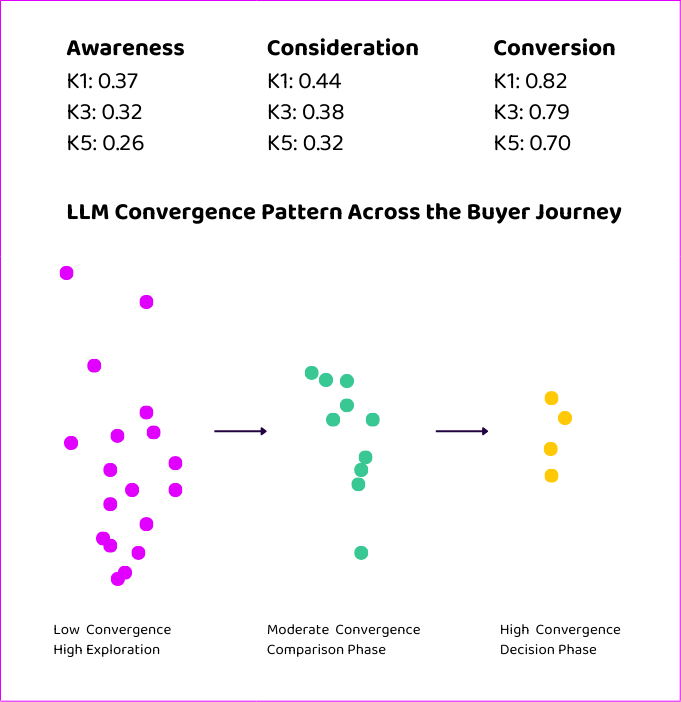
At awareness, canon concentration is low. K1 sits at 0.37, K3 at 0.32, K5 at 0.26. The model is exploring. It names different brands across runs, uses descriptive and category-level language, and shows high variability. The option space is wide open.
At consideration, concentration increases modestly. K1 rises to 0.44, K3 to 0.38, K5 to 0.32. The model is starting to cluster around a partial shortlist, comparing approaches and evaluating trade-offs. But there’s still meaningful variation. The shortlist isn’t locked.
At conversion, concentration spikes. K1 hits 0.82. K3 reaches 0.79. K5 lands at 0.70. The model has converged. It names essentially the same brands every single time, uses directive language (“best for,” “recommended,” “top choice”), and rarely introduces new options. The option pool has collapsed to a tight, enforced set.
This pattern tells you something fundamental about how LLMs talk about brands. They show a behaviour called “intent matching”. When the intent of a prompt is decision-oriented, the model goes from exploratory mode to decision-mode to match the user’s needs. In that process, it becomes more risk-averse and highly consistent in the brands it surfaces. It constrains the option pool to just a few brands and rarely deviates.
Why This Breaks Conventional AEO Measurement
If you’re tracking brand mentions, citation counts, or LLM referral traffic without knowing the canon concentration of the prompts generating those signals, you’re comparing fundamentally different environments as though they’re equivalent. A mention in a K1 environment (awareness, wide-open exploration) means something different from a mention in a K1 = 0.82 environment (conversion, tight convergence).
High canon environments mechanically inflate visibility for brands.
Our research is explicit about this: high citation or mention rates in converged (generally, bottom-of-funnel) prompts reflect the structure of the task and the narrow options far more than the effectiveness of any specific AEO activity. It’s the strength of your brand, not your shiny FAQ or “AI-optimized” article that is driving it.
That visibility is still a good thing, but the investment decisions you’re likely to make from it will be misinformed. You’re mistaking correlation for causation.
In the above example, there’s very little benefit to investing more or cost to investing less. Your strategy should be focused on funnelling more buyers into the option pool in which you’re visible, which requires a very different strategic approach and investments.
Canon concentration is therefore critical context to ensure that you’re able to make smart decisions from your AEO performance data.
The Self-Fulfilling Prophecy
Canon concentration also reveals a more insidious measurement flaw: how teams build their tracked prompt lists.
Many brands scrape their own sites to generate the prompts they monitor in AI. This is the approach many AEO providers encourage, but it is flawed in a fairly obvious way.
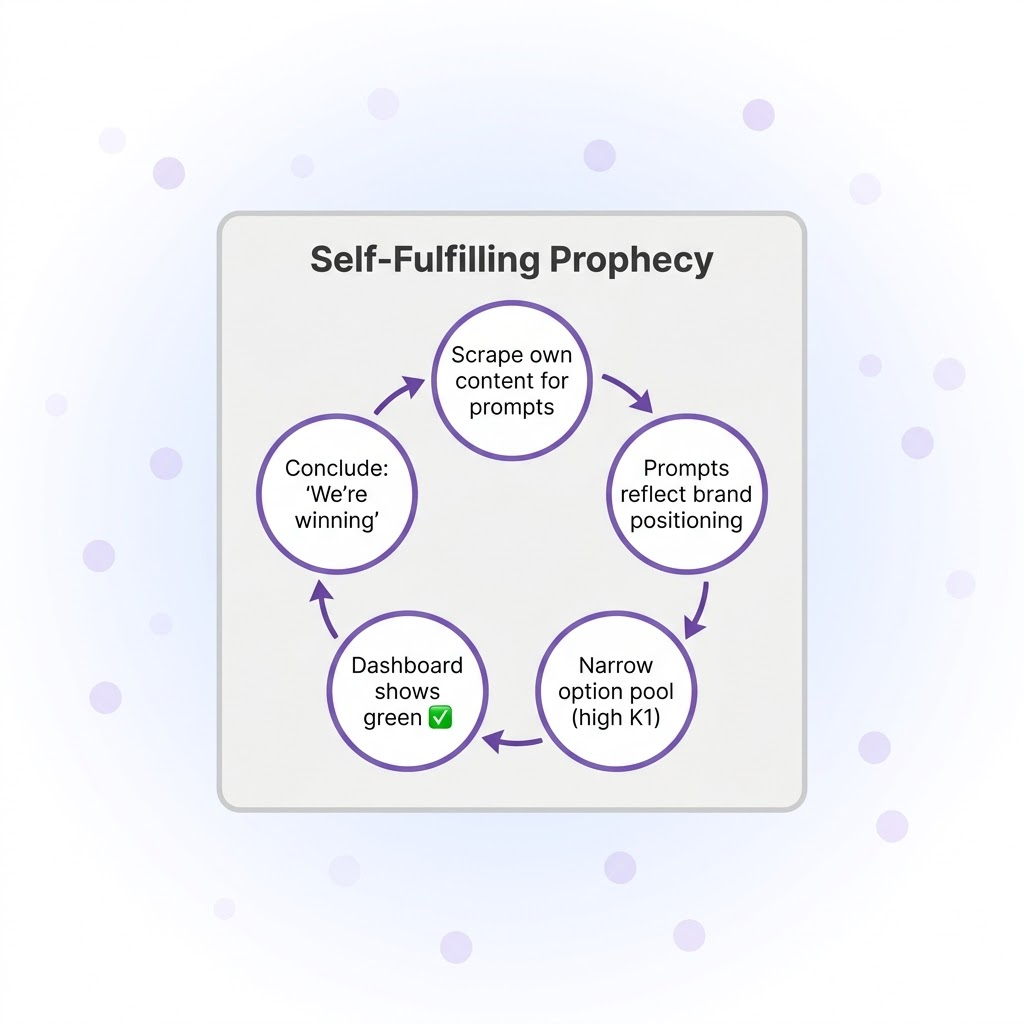
Those prompts naturally reflect the brand’s own positioning and category language. They tend to be decision-oriented (“best X for Y,” “which platform should I choose for Z”) because that’s what the brand’s content is designed to answer.
You end up tracking prompts where the option pool is already narrow, convergence is already high, and you’re already likely to appear. The dashboard looks great. You conclude “we’re doing well” based on a small, potentially flawed sample while missing the upstream exploratory conversations where the model is still deciding which brands matter.
Canon concentration lets you audit this bias directly. If most of your tracked prompts have K1 scores above 0.7, there’s a high risk of a self-fulfilling prophecy. You’re measuring visibility where visibility is pre-determined.
Is it a bad thing? No. I want to be visible within our natural sphere of influence. But I also want to know if I’m helping funnel more people in that direction, and if the money I’m spending is actually making an impact.
How to Use Canon Concentration
First, when you’re choosing what prompts to track, build clusters intentionally to span awareness, consideration, and conversion journey stages for your category. Don’t just scrape your site. Think through your buyer’s journey and ensure that you’re capturing at least a sample at each stage. Include the exploratory, problem-framing prompts that buyers use before they know your brand exists.
This is where a lot of AEO strategy goes back to marketing 101. Understand your buyer journey in detail so that you can add value at every stage.
Second, and this is where it’s harder if you’re measuring AEO internally or your vendor doesn’t provide adjusted metrics, but run each prompt multiple times. Compute K1, K3, and K5 across runs – essentially, analyse the level of variability in which brands are surfaced in each one. Then use those scores as context for every other metric you report.
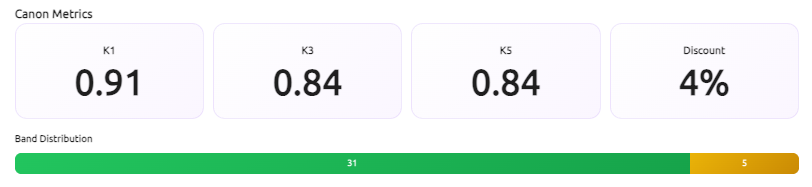
A brand mention at K1 = 0.82 is less indicative of influence and impact than a mention where K1 = 0.37.
This is why we use canon-weighted visibility as a north star metric. It rewards appearances in low-canon environments (where the model is still exploring and your content can shape its thinking) more than appearances in high-canon environments (where convergence has already locked the shortlist). BOFU visibility still matters, but it’s an outcome, not a lever. Weighting it equally with upstream influence distorts your picture of what’s actually driving results.
Where Canon Concentration Fits in the Bigger Picture
Canon concentration is one piece of the measurement framework we propose in our Dark AI research report. Overall, we recommend building your AEO strategy less around visibility and citations, and more around demonstrating “fit” against different criteria. How does the LLM view your strengths and weaknesses, and how does that map to your buyer’s needs in each of your different segments?
With so many potential prompts in a complex journey, and so many potential variations of each, that’s the only reliable way to ensure you’re capturing how you show up across all those possible variations. Understand the LLM’s true perception of your brand, and optimize for that, rather than any specific query.
Visibility is still a factor, though, and Canon Concentration is the context that makes it a reliable signal. Without it, you don’t know if your visibility is earned or structural. You don’t know if your measurement is capturing influence or confirming convergence. And you don’t know whether the prompts you’re tracking are the ones where your strategy can actually make a difference, or the ones where the model has already made up its mind.