



If you’re searching “how to manage content debt”, you’re probably already noticing the symptoms: outdated pages referencing old data, contradicting each other in terms of your positioning and a growing sense that your content library is not telling a clear, consistent story that reflects who you are today.
Content debt accumulates quietly, but as brands leverage AI to increase output, it can accumulate quickly. We recently analysed over 50,000 pieces of B2B content and it revealed the extent to which brands have been increasing the surface area of their content library, and taking on debt. Brand are building “always-on” content engines, with a massive uptick in content velocity.
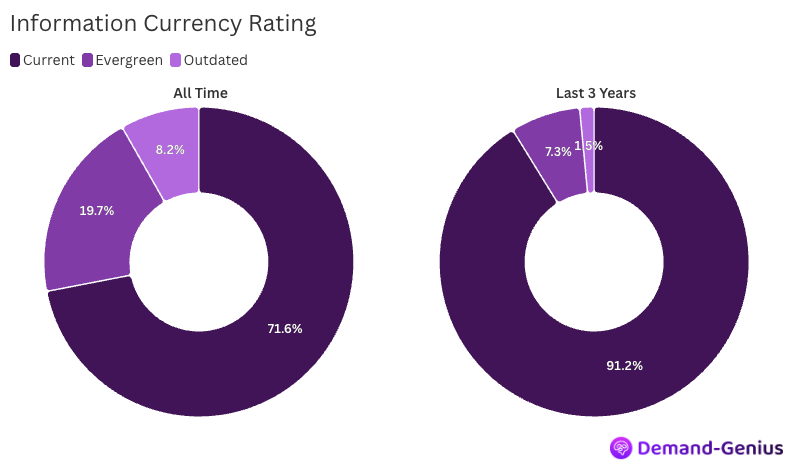
The challenge is that just 7% of the content created in the last 3 years is “evergreen”. The vast majority is “current” but that is all content which, without maintenance, will eventually devolve into outdated content. That is content debt.
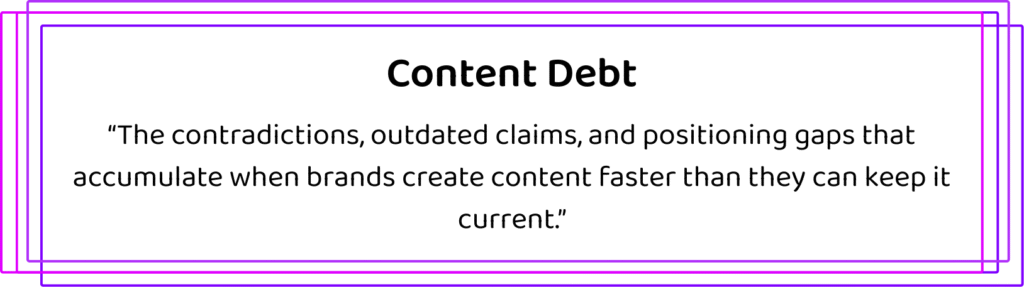
What is Content Debt, and How does it Build?
There are many long-standing operational reasons why content debt can build:
- Teams create faster than they maintain, leaving behind outdated data or disproven arguments.
- Ownership changes without handoffs
- “Temporary” content (landing pages, etc) isn’t properly managed.
- Tech migrations leave orphaned content behind
There is also a more subtle way in which brands accumulate debt quietly over time, as a consequence of perfectly solid marketing practices.
As brands evolve their positioning over time, they create new content and reputational touchpoints (reviews, etc) that align with that positioning. The challenge is that most brands have now done this over the course of 5, 10 or 20 years. With each evolution, a gap opens up between who you are and who you were. In that gap lies contradictions, and that is your content debt.
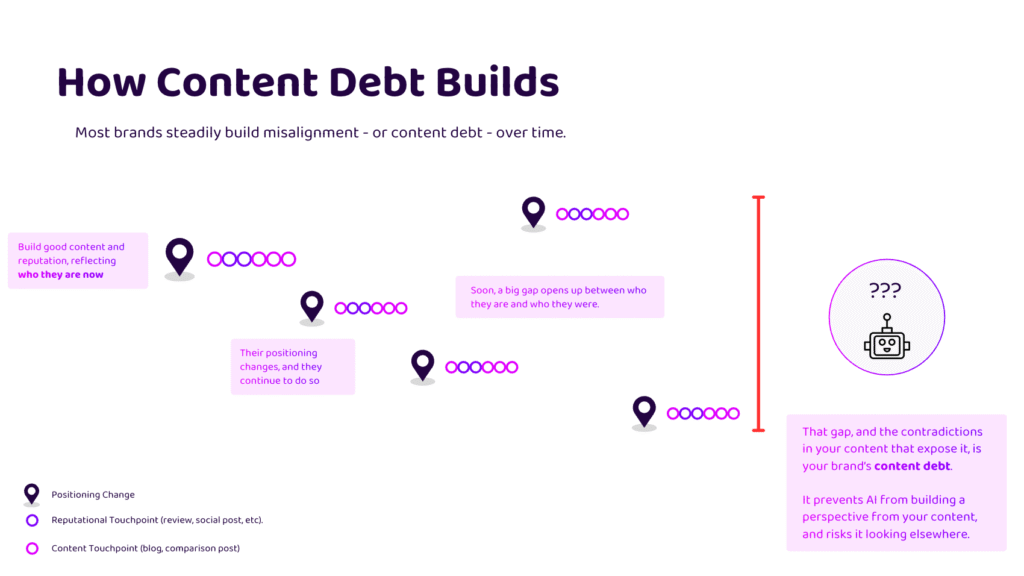
Every time you expand the surface area of your content library, you take on a maintenance debt that must be paid. The creation of content debt is not a bad thing in itself. Publishing (quality) new content, adapting your positioning, tweaking your messaging – these are all things that brands absolutely need to be doing. The big difference in today’s world, though, is that there are more consequences to content debt. Old or irrelevant content doesn’t just gather digital dust.
Why does Content Debt matter more in the AI Era?
Content debt degrades user experience, suppresses SEO performance, wastes operational time, and increases legal/compliance risk. In the AI era, though, it carries a more significant cost and can do real damage to your brand’s visibility in and influence over AI responses.
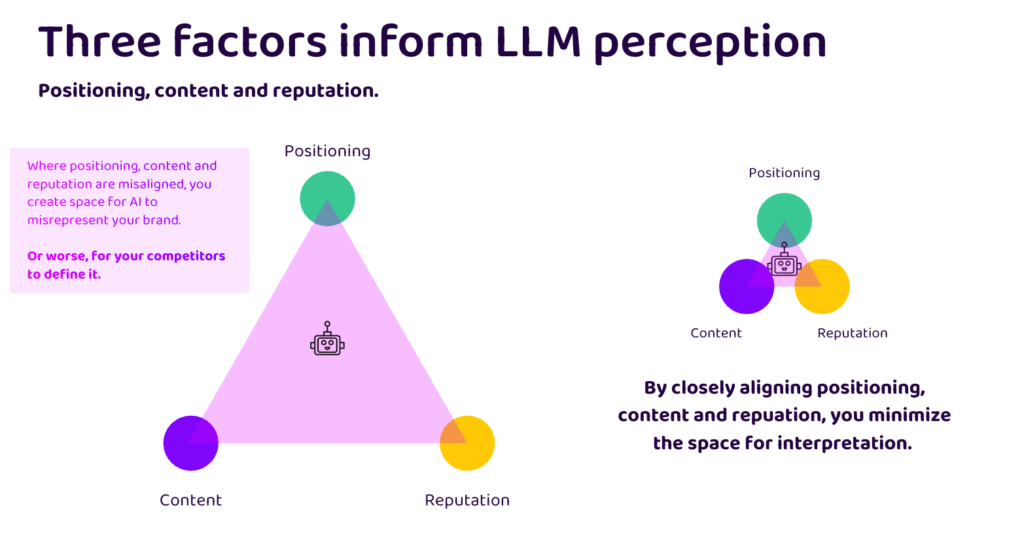
AI systems don’t browse your site like humans do, and nor do they index it like Search engines do. Search engines match content to keywords in a 1:1 relationship. AI systems synthesize information across your entire footprint, pulling from multiple pages simultaneously. If your pricing page says one thing and your FAQ says another, AI may confidently present a wrong hybrid answer to potential customers.
Every contradiction you leave around who you are, who you’re for and when or how to recommend you creates uncertainty, and a window for AI to misrepresent you or worse, for a competitor to resolve that uncertainty in their own content.
Managing your content debt gives you the best possible chance of ensuring you remain the authority on yourself. We have a hypothesis we are looking to test that high levels of content debt is why comparison content is proving impactful in AEO. Every contradiction creates uncertainty, and in that uncertainty misinterpretations or hallucinations can occur, or competitors can resolve it with their own comparative content.
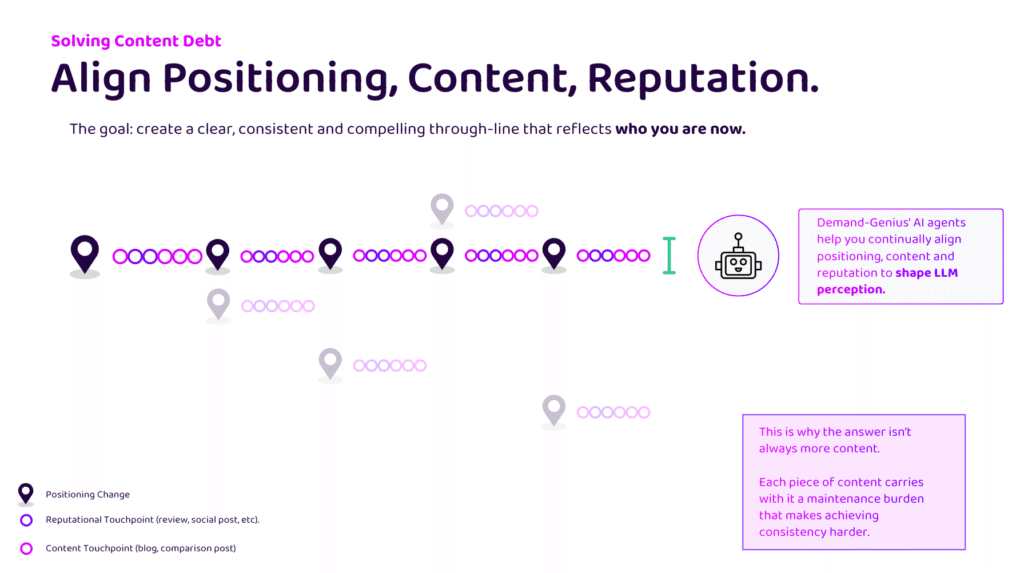
The challenge is that most teams don’t have a systematic, efficient way to manage and resolve content debt beyond basic technical and structural issues.
We firmly believe this needs to be a process and discipline, rather than a project or “spring clean”. For most brands, the first task is going to be to conduct a content audit that assesses and resolves what is likely to be quite significant content debt, though. For guidance on that process you can check out our separate guide to conducting a content audit. This guide focuses on providing a practical framework for the ongoing evaluation and management of content debt.
Step-by-Step Guide to Managing Content Debt
Managing content debt requires two different types of ongoing analysis. Quantitative analysis catches technical and structural debt: broken links, missing metadata, orphaned pages. Qualitative analysis catches narrative debt: contradictions in positioning, outdated claims, gaps in coverage, and inconsistencies across your content library.
Most brands will already have processes and technologies in place to spot and resolve any technical or structural issues in the content. It’s a longstanding SEO practice. But AI systems don’t just find your content, they synthesise it, pulling from multiple pages simultaneously to form judgments about your brand. Every contradiction or inconsistency can hurt the way LLMs perceive, and therefore present, your brand. That’s why it’s crucial to to maintain clarity, currency and consistency across your entire library, which necessitates ongoing, quality-oriented content maintenance.
This guide focuses primarily on qualitative analysis because it’s newer, harder to operationalise, and most teams don’t have a systematic approach to it yet. But for those that don’t have a mature SEO strategy to build on, we’ll start with a quick look at that.
Technical Content Debt Management: The Basics
Most teams already have quantitative monitoring in place. If you don’t, here’s what you need to track and how to do it efficiently.
What to Monitor
Technical health: Broken links, redirect chains, orphaned pages (findable by crawlers but not linked from anywhere on your site), pages blocked from crawlers, slow load times.
Metadata consistency: Missing or duplicate title tags and meta descriptions. More subtly, metadata that contradicts your current messaging (old positioning language, deprecated product names, outdated value props).
Structural issues: Page depth (how many clicks from homepage), broken internal linking, content silos where related pages don’t link to each other.
Performance signals: Pages getting traffic but producing zero conversions, high bounce rates signalling content-promise mismatch, pages in active buyer journeys that haven’t been updated in 18+ months. It’s important to remember that low traffic in itself does not necessarily mean content should be deprecated – it’s important to understand the nature and source of that traffic. An article could be getting 10 visits a month, but if they’re coming from your primary decision maker at proposal stage of your sales process, you probably want to keep that article around!
How to Monitor It
There are various affordable SEO tools that will allow you to run a periodic technical audit, including:
Screaming Frog: Crawl-based technical audits. Free version handles up to 500 URLs, paid version scales to large sites. Best for pure technical health checks.
Ahrefs Site Audit: Comprehensive technical and SEO health monitoring. Strong for identifying orphaned content and internal linking issues. Good content decay tracking based on last update date.
Semrush Site Audit: Similar coverage to Ahrefs. Includes content decay scoring based on freshness and engagement metrics.
Pick one, run it quarterly, fix any issues. The tools are great for surfacing what are usually quite straightforward fixes: redirect broken links, update metadata, restore internal links to orphaned pages, consolidate or archive low-value content.
Narrative Debt Management for AEO
A technical audit tells you a page exists and is findable. It doesn’t tell you if it’s any good. And in fast moving markets, “good” is a moving target. However well written, if a page contradicts your current positioning or if it’s out of sync with the rest of your library, it’s working against you when AI systems synthesize your content.
Why Qualitative Debt is the AI-Era Problem
AI systems consume your entire content footprint to form judgments about your brand. Unlike search engines that match keywords to pages in a 1:1 relationship, LLMs extract signals across multiple pages simultaneously. You need a process to ensure content quality, not just discoverability, is maintained across your entire library.
If your homepage positions you as enterprise-focused but your case studies feature SMB customers, AI might confidently tell a buyer you serve mid-market companies. If your pricing page says “starting at $500/month” but your FAQ says “plans begin at $750/month,” AI will pick one, blend them into something wrong, or hedge with vague language that erodes confidence.
The challenge is that deep, qualitative analysis to detect narrative inconsistencies is harder to conduct at scale than technical audits. Existing tools don’t let you crawl your site and flag “narrative contradiction” the way you flag “404 error.” This requires reading content, understanding context, and identifying patterns across your entire library.
Fortunately, as AI has compounded the problem, it also provides the solution. AI agents enable marketing teams to continuously run human-like analysis of content, at scale, to flag more nuanced issues immediately.
The Framework for Qualitative Monitoring
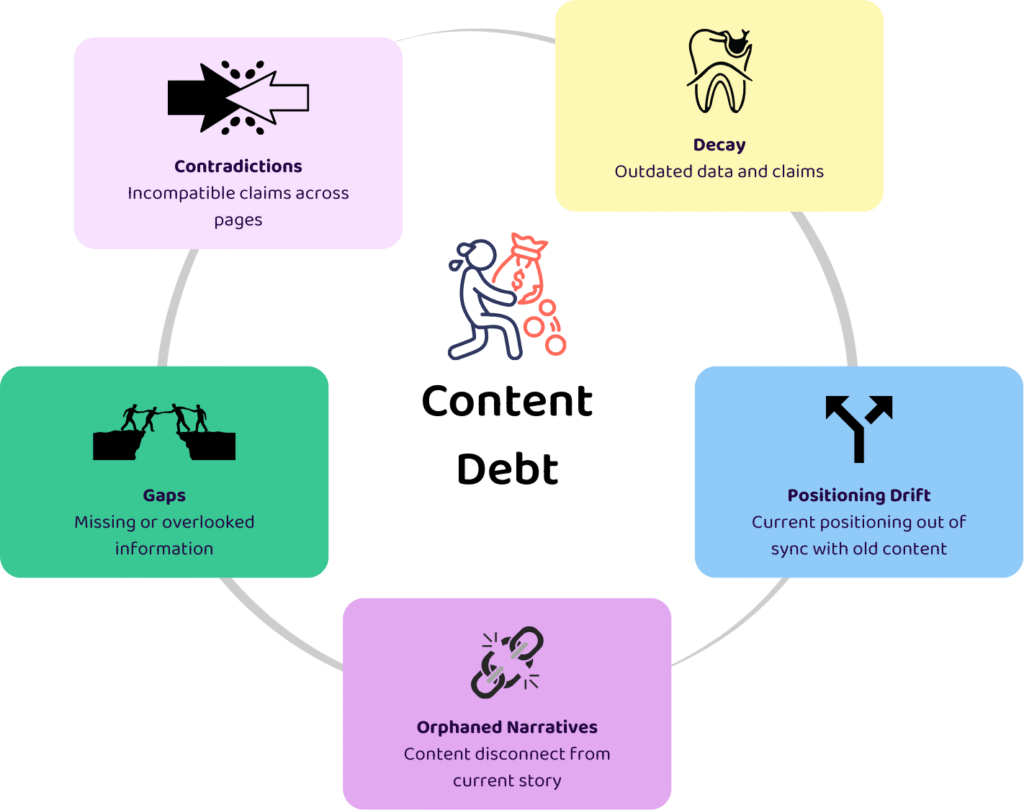
We’ve developed a framework for identifying the different forms of narrative debt that can hold back AI search performance. Generally, there’s five categories:
1. Contradictions: Different pages making incompatible claims about pricing, positioning, capabilities, or target audience. Example: Your homepage says “built for enterprise teams of 500+” while your case studies showcase companies with 50 employees.
2. Currency decay: Content referencing outdated data, old product versions, deprecated features, or arguments that no longer hold. Example: A 2020 blog post claiming “most buyers prefer phone calls” when your 2024 data shows they want async communication.
3. Positioning drift: Old content reflecting previous positioning that no longer matches who you are today. Example: Legacy content positioning you as a generalist tool when you’ve since focused on a specific vertical.
4. Coverage gaps: New questions buyers ask that your content doesn’t answer, creating space for competitors to fill. Example: You sell project management software but have no content addressing remote team collaboration challenges. As markets evolve and innovate faster than ever, the speed with which “definitive guides” cease to become definitive is acceleratiing.
5. Orphaned narratives: Content that exists but doesn’t connect to your current story. Old campaign landing pages, sunset product documentation, deprecated messaging frameworks that contradict current positioning.
To identify these, you need to be evaluating your content across five dimensions that we know inform AI perception:
- Clarity: Can AI systems extract clear, unambiguous signals from this content? Or is it vague, hedged, or ambiguous in ways that reduce AI confidence?
- Confidence: Does the content make authoritative claims backed by evidence?
- Currency: Is the information current and relevant? Does it reference recent data, current product versions, and up-to-date market conditions?
- Transparency: Are sources, data points, and claims properly supported? Can readers (and AI systems) verify what you’re saying?
- Consistency: Do the messaging, positioning and CTAs align with your brand’s core narratives, ICP and product descriptions?
This is the framework Demand Genius uses to audit content at scale. You can apply it manually, build your own AI-powered analysis tools, or use a platform that does it continuously. What matters is having a system that operationalises qualitative review so it becomes a discipline, not a one-time project.
The sections below focus on how to actually run qualitative debt management operationally, regardless of which approach you choose.
Establish Your Qualitative Monitoring Cadence
Qualitative monitoring can’t be a one-time audit. It needs to be continuous, but you can tier your monitoring based on content importance.
The Operational Challenge: How to Monitor at Scale
Before we get into cadence, you need to decide how you’ll actually do qualitative monitoring. You have three options:
Do it manually: Assign team members to read and audit content. This doesn’t scale past small libraries and is hard to maintain as a discipline.
Build it yourself: Use Claude, GPT, or other LLMs to audit content programmatically. Write prompts that check for contradictions, currency, and consistency. This works but requires technical setup and ongoing prompt refinement.
Use a platform: Tools like Demand Genius run continuous qualitative analysis across your entire library, flagging contradictions, tracking positioning drift, and monitoring narrative coherence.
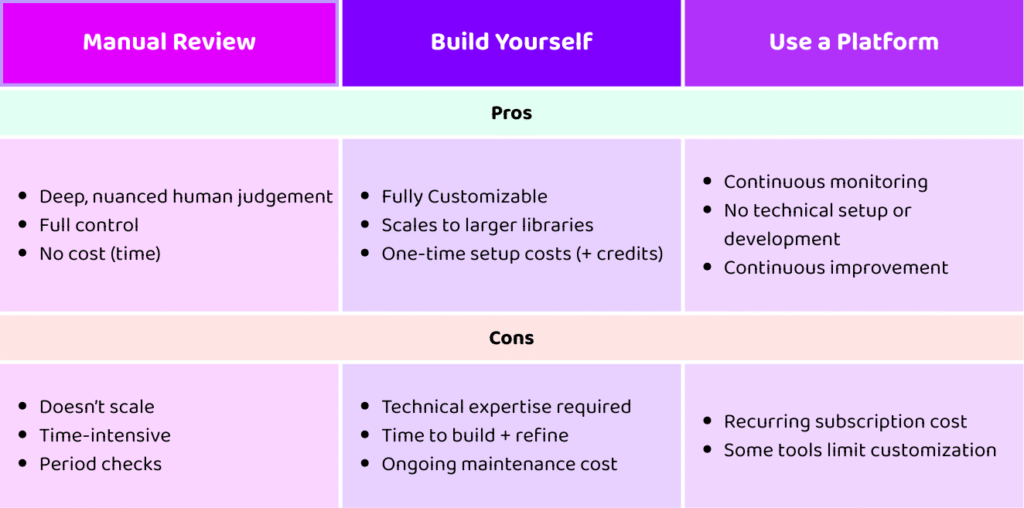
The choice depends on your content velocity, library size, and team capacity. What matters is having a system that operationalizes qualitative review so it becomes a discipline, not a one-time project.
Manual review might work if you’re publishing 2-3 pieces per month with a library under 100 pages. Beyond that, you need AI-powered analysis to make continuous monitoring and triggered reviews feasible. The cadence recommendations below assume you have some form of automated analysis in place.
Continuous Monitoring for High-Stakes Content
Your homepage, core product pages, and pricing pages shape first impressions and AI perception. These should be monitored continuously, and given their importance, that review should be manual – though AI might help.
Where AI should be deployed is to ensure that any change to these pages triggers a review of related content.
Pages that directly support product positioning such as comparison pages are regularly used by Sales teams, influence AI perception and are accessed by prospects with decisional intent. Contradictions and inconsistencies here can do immediate damage and blur areas of comparison that directly impact purchasing decisions.
Quarterly Reviews for Core Library
Pillar content, resource pages, case studies, and product documentation should be reviewed quarterly at least. Check for:
- Currency: Are stats, data points, and examples still current and relevant?
- Consistency: Do these pages still align with current positioning?
- Coverage: Are there new buyer questions these pages should address?
Quarterly cadence balances thoroughness with team capacity. Most core content doesn’t change fast enough to warrant monthly review, but longer gaps let debt accumulate.
Triggered Reviews for Positioning Changes
Any time your positioning shifts, you need triggered reviews across your entire library. Common triggers:
- Product Marketing updates messaging or repositions the product
- Product ships new features that change your story
- Sales reports new objections or buyer questions
- Competitive landscape shifts (new entrants, category redefinition)
When these happen, identify all content that touches the changed narrative and review for consistency. This is where most teams fail. They update the homepage and pitch deck but leave 50 blog posts with the old positioning.
This is where AI-powered analysis becomes essential. Manually reviewing your entire library every time positioning shifts doesn’t scale. You need a system that can flag all content referencing old positioning, contradicting new messaging, or creating confusion.
Setting the Cadence
Your monitoring frequency, and therefore the methodology, should scale with:
- Content velocity: Publishing 10 pieces per month? You need tighter monitoring than a team publishing 2 pieces per quarter.
- Positioning stability: If you’re repositioning frequently (common in early-stage companies), you need more frequent triggered reviews to catch drift.
- Competitive pressure: Fast-moving categories where competitors shift narratives often require tighter monitoring to stay aligned.
The goal is to catch debt before it can accumulate .
The Benefit of Using a Platform: Real-time vs. Periodic Monitoring
You can run quarterly checks manually using AI, or build your own workflows that scan content on a schedule. Leveraging a platform like Demand-Genius helps to reduce the overall workload as well as shifting from periodic checks to real-time monitoring.
Think of it like home security. You could walk through your house every week checking that windows are locked and doors are secure. That’s periodic monitoring. Or you could install sensors that alert you the moment something breaks.
The difference matters more as your content velocity increases. If you’re publishing daily, quarterly checks mean you could accumulate three months of contradictions before catching them. Platforms let you act immediately rather than periodically, which means debt never has time to compound, and you don’t waste time checking for issues that aren’t there.
Create Ownership and Accountability
It’s easy for maintenance activity to fall through the cracks, so it’s important to be clear on who owns it, what you expect, and build it into their goals and KPIs.
Balance Creation with Maintenance
Most content teams operate on a 95/5 split: 95% of effort goes to creating new content, 5% goes to maintaining existing content. This worked in a search-led environment where volume drove visibility. In an AI-mediated environment, your team’s split should be closer to 50/50. Half your effort creates new content. Half maintains, updates, and improves what already exists.
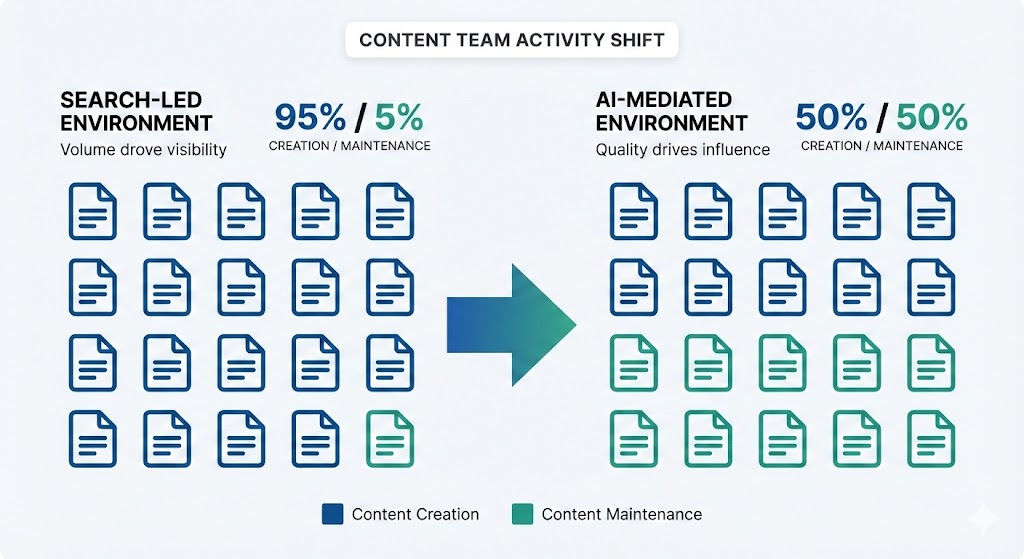
The best content teams have already made this shift. They publish less and maintain more, honing in on quality and “information gain” as primary content goals and looking at ways to quantify and safeguard them.
Build a Content Directory with Qualitative Scores
You need a single source of truth that tracks not just what content exists, but its qualitative health.
At minimum, build a content directory that includes:
- URL or content title
- Current owner
- Last review date
- Next scheduled review
- Content type (evergreen, current, temporary)
- Business function it supports (demand gen, sales enablement, brand)
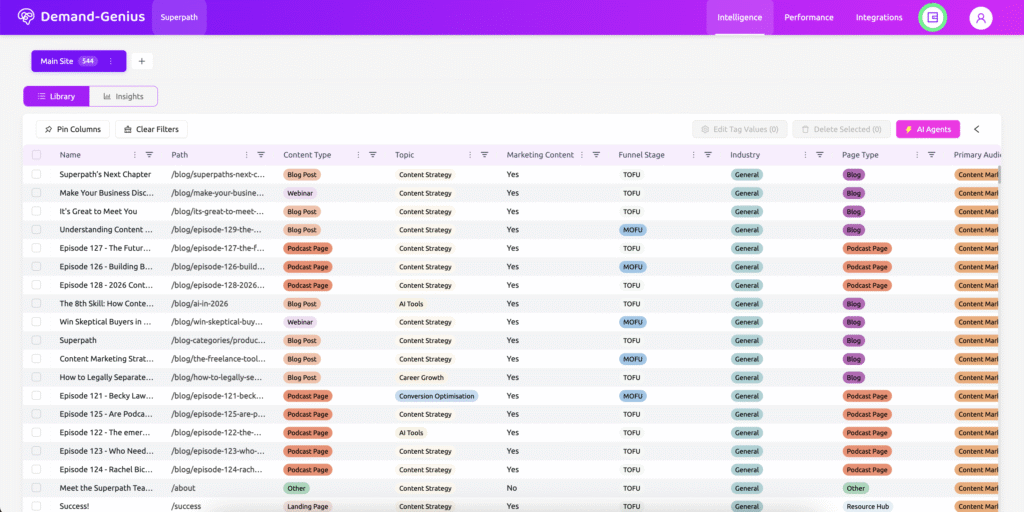
The benefit of leveraging AI to support this process, is that you can configure this to continuously flag issues and reduce qualitative analysis to more trackable metrics. Look to track:
- Clarity score (Strong / Acceptable / Weak)
- Confidence score (Strong / Acceptable / Weak)
- Currency score (Strong / Acceptable / Weak)
- Transparency score (Strong / Acceptable / Weak)
- Consistency score (Strong / Acceptable / Weak)
The qualitative scores create visibility into content health. When you can see that 40% of your BOFU content has “Weak” consistency scores, you have a clear maintenance priority. These scores should form a key part of your content team’s KPIs.
This can live in a spreadsheet, Airtable, or your content management system. If you’re using a platform like Demand Genius, these scores can be continuously maintained by AI agents, along with detail as to how to resolve them. If you’re doing it manually or building your own system, you’ll need to score content as part of your review process.
Conclusion: Content Maintenance is a Critical AEO Discipline
Winning in AI Search isn’t about maximising output or optimising content for specific prompt clusters – it’s about aligning positioning, content and reputation as closely as possible to communicate who you are and who you’re for with minimal margin for interpretation.
This requires a mindset shift. Marketing teams need to prioritise content quality of quantity, and to assess that across a content library as a whole rather than viewing each piece in isolation.
Start with the basics. Establish your monitoring cadence. Build your content directory with qualitative scores. Shift team expectations from creation to maintenance. Set triggered reviews for positioning changes. Make debt visible, measurable, and someone’s responsibility.
Manage Content Debt at Scale with Demand Genius
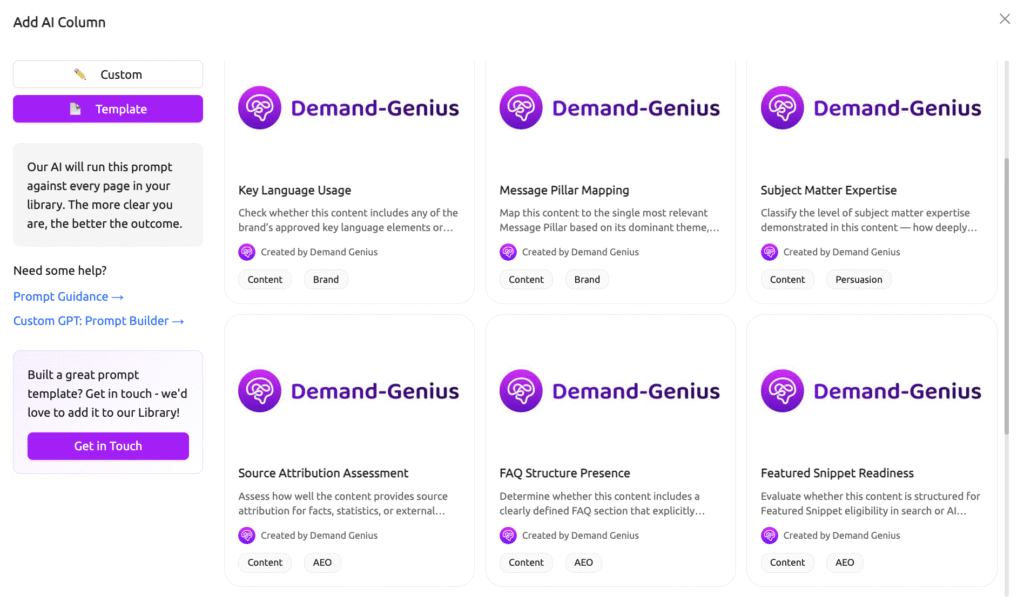
Demand Genius makes it easy to configure pre-built or custom AI agents to automatically monitor and score content quality, assessing against the five dimensions that shape AI perception: clarity, confidence, currency, transparency, and consistency.
The result: you catch debt before it piles up, and ensure AI systems can recommend you with confidence instead of hedging or presenting competitor framing.
If you’re managing a content library of 100+ pages and struggling to maintain consistency across your footprint, Demand Genius can help. Get started now with a free AI content audit.