



There are thousands of ways a B2B buyer can ask the same question.
“Best CRM for startups.” “What CRM should a 10-person team use?” “Lightweight alternatives to Salesforce for small teams.” It is impossible to capture all the different variations whilst maintaining a clear, reporting-friendly picture of where your brand is visible.
That’s what intent clusters do. They group related prompts by the underlying job the buyer is trying to get done, so you measure visibility at the level that matters: not the specific phrasing, but the question or intent behind it.
This post walks through how to build out your list of prompts to track, and structure them so the data is useful.
How to Think About Cluster Structure
There are different ways to organise intent clusters. Some companies group them by product line. Others by audience segment or vertical. What we tend to see work best, particularly for B2B brands with complex buying journeys, is mapping clusters to jobs to be done (JTBD).
Your buyers leverage AI to support them at every stage of their journey. The first question you need to answer is which of those jobs do you want to influence?
We view this in two categories. Product jobs (the things your tool helps people accomplish) and buyer jobs (the problems buyers must solve before or alongside purchasing it).
For a CRM, product jobs might include pipeline management, contact data quality, revenue forecasting, integrations. For a payments company, it’s accepting card payments, managing online checkout, understanding fees.
Buyer jobs are the tasks a buyer goes through when making a purchasing decision. Building a requirements list. Understanding the category. Comparing approaches. Building consensus across stakeholders. Making a business case for budget.
Most teams instinctively build clusters around product jobs.
The challenge with that approach is that it limits your visibility tracking to the bottom-of-funnel, solution-focused queries that we know form only a fraction of a complex purchasing journey. Our Dark AI research showed that AI visibility is largely a consequence of a pattern called convergence. LLMs converge on recommendations, they don’t search for them. Visibility at the bottom of the funnel is a consequence of influence at the top, shaping the way problems are framed in your favour.
Your goal is to influence the criteria AI applies in framing your buyer’s problem, in such a way as to make your visibility inevitable for more potential buyers.
By adopting your buyer’s perspective in constructing intent clusters, you can ensure that your visibility tracking meaningfully represents how you show up during the problem framing and requirement building phases.
The Framework for Constructing Your Clusters
Once you have your jobs defined, you need to work through the different perspectives that might be applied to those JTBD to build a representative list of specific queries in each cluster.
The natural temptation is to have AI generate prompt clusters. There is a major risk to this, though – typically, brands have AI do this by analysing their site and picking out relevant prompts. There is an obvious self-fulfilling prophecy here. You will inevitably create a list biased on your own favour.
On the flip side, sitting down and manually building a well structured, representative list of buyer questions is difficult and time consuming. We recommend following a simple framework that blends the best of both worlds to ensure you are feeding accurate context into that approach, then letting AI fill out the detail.
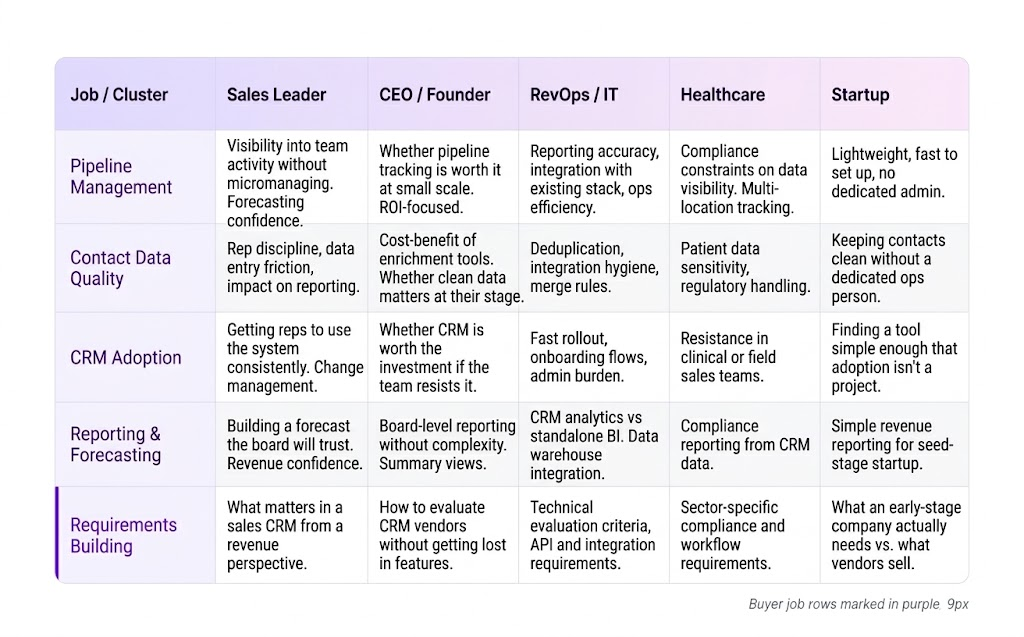
Map out the key JTBD and the different approaches buyers might take to that JTBD in a simple table or – if you want a fancy word for it – a JTBD matrix.
Rows are your jobs. Columns are the key variables that change how that job gets framed: personas, verticals, company stages, product tiers.
What’s the slant this person or context puts on this job? What are they concerned about? What’s their framing?
Here’s what that looks like for a CRM company.
And for a payments company.
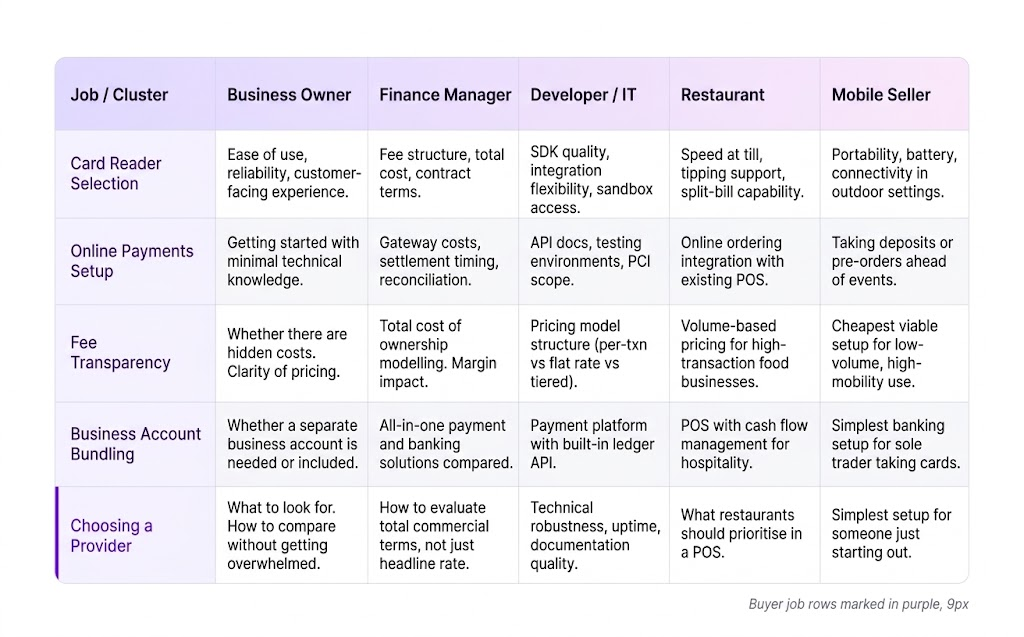
Each cell captures a perspective, not a phrasing. “Compliance constraints on data visibility” is a slant. It tells you the concern, the framing, the angle that a healthcare buyer brings to pipeline management. That’s the input AI needs to generate the actual prompt language really effectively.
From Grid to Prompts
Once your grid is complete, it becomes the context for a single generation step. Take the grid, pass it to an AI assistant, and ask it to produce up to 25 natural language prompts per cluster that reflect the angles described in each cell.
Here is a prompt that you can adapt with your own specific context:
Context: I sell [your product category]. I’m building prompt lists for AI visibility tracking — I need to understand how real buyers ask about my category in AI assistants like ChatGPT and Claude, so I can monitor whether my brand appears in those conversations. Below is my intent cluster grid. Each row is a cluster representing a job a buyer is trying to get done. The columns are modifiers (personas, verticals, company stages). Each cell describes the angle or concern that modifier brings to that job.
[Paste your completed grid here]
Task: For each row (cluster), generate up to 25 prompts that a real B2B buyer would type into an AI assistant during their purchase research. Use the angles in each cell to ensure the prompts reflect the full range of perspectives across the row. Each prompt should:
- Sound like a genuine question someone would ask an AI, not a Google search or keyword string
- Be specific enough to get a useful answer (include context like company size, role, or industry where the angle calls for it)
- Cover a mix of problem-framing, requirements-building, comparison, and sceptical/challenging prompts
- Avoid mentioning any specific vendor or brand name
Output: Return the prompts grouped by cluster. For each cluster, number the prompts 1–25. Flag any prompts that represent a buyer job (e.g. requirements-building, vendor evaluation) rather than a product job, so I can see the balance.
This is significantly easier than asking people to dream up 25 realistic prompts per cluster from scratch. You capture the strategic thinking (what are people actually concerned about?) and let the model handle the linguistic variation (how would they phrase that?).
A few things worth noting:
Review the output. AI-generated prompts are a strong starting point, but they can drift into marketing language or implausible phrasing. Strip out anything that reads like a keyword search or a vendor’s pitch rather than a genuine buyer question.
Don’t only track what you wish people were asking. The gap between what you want buyers to ask and what they actually ask is what you need to capture to get an accurate picture of your brand’s visibility.
What Comes Next?
Connect Clusters to Your Content Strategy
Each intent cluster is a territory you want to own in AI. That makes your cluster set a natural organising principle for your content roadmap.
Using Smart Columns within Demand-Genius, you can analyse your existing content library’s coverage against this JTBD framework to understand where your coverage gaps are and how that maps to visibility and performance. This is where Demand-Genius can help you to shape both visibility and perception by isolating the gaps in your existing library.
Living Clusters: Revisit and Refine
Markets move faster than ever. The language buyers use changes. New competitors enter. Categories shift. The prompts that mattered six months ago may not capture the full picture today.
Revisit your clusters quarterly at minimum. Look at which prompts produce the most volatile results, because those may signal a shift in how the category is being discussed. Think about new jobs that have emerged. Remove prompts that no longer reflect how buyers phrase the question.
If you’re running Demand-Genius with the Performance module connected, your clusters can auto-optimise based on real engagement data, surfacing new prompts that buyers are actually using based on buyer journey and engagement data. That takes the manual work out of the refresh cycle and keeps your tracking representative as language evolves.