


Most AEO advice right now boils down to a recycled SEO playbook: track brand mentions, count citations, optimise content to rank in AI responses. It’s familiar and measurable. But when it comes to complex B2B, it’s largely measuring the wrong thing.
When we ran our multi-vertical research into how LLMs actually handle B2B buyer prompts, we found that citations and retrieval don’t appear until the very end of the buyer journey. Before that, the model is working from memory, not from your carefully optimised page.
That means the stage where buyers define problems and form requirements, what we call Dark AI, happens with no citations, no referral traffic, and no visible signal that your content shaped anything.
The lever that determines whether your brand shows up in that space isn’t the status quo aspects like schema markup or AI-generated FAQs.
It’s something what we call “information gain”.
What Information Gain Actually Means
We define information gain as whether a piece of content adds net new understanding to a problem space. Not keyword coverage, not snippet readiness, but whether it actually teaches the model something it didn’t already know.
This matters because of how LLMs construct early-stage responses. At awareness and consideration, models aren’t retrieving and citing sources. They’re drawing on patterns and conceptual associations absorbed during training. Content that merely summarises existing thinking doesn’t shift those patterns, it reinforces them. The model already knows what you’re saying, because a hundred other pages said it first.
If an LLM could generate the same piece from existing sources, you’re not contributing information gain. You’re producing content the model can already replace.
The Four Levels of Information Gain
To make information gain operational rather than aspirational, we developed a four-level framework that gives content teams a concrete way to classify and audit their output.
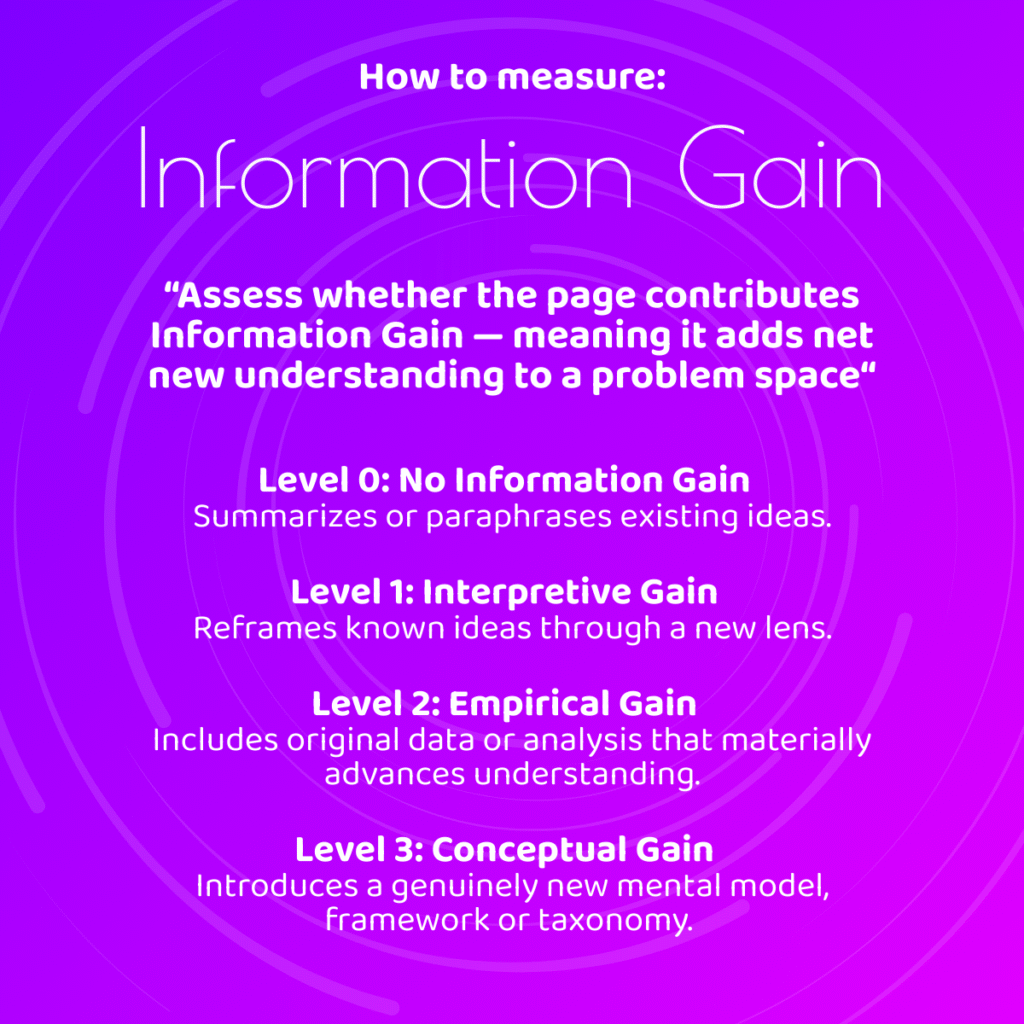
- Level 0: No Information Gain. The content summarises or paraphrases existing ideas. It covers familiar ground in familiar ways. This is where most thought leadership lives: competent, correct, and completely interchangeable with what the model already knows. A well-written explainer of a concept that’s been explained a thousand times is still Level 0.
- Level 1: Interpretive Gain. The content reframes known ideas through a new lens. It doesn’t introduce new data, but it offers a perspective that changes how the reader, and potentially the model, understands a familiar topic. It could be a contrarian take backed by strong reasoning, or a connection between two domains that haven’t been linked before. Level 1 content shifts framing without adding empirical evidence.
- Level 2: Empirical Gain. The content presents original data or benchmarks that materially advance understanding of the problem space. This is where research reports, proprietary benchmarks, and original case analysis live. The model can’t generate this from existing sources because the data didn’t exist before you published it. Level 2 content changes what the market knows, not just how it thinks about what it already knows.
- Level 3: Conceptual Gain. The content introduces a genuinely new mental model, framework, or taxonomy. It creates a new way of organising understanding, a concept that others then reference, adopt, and build on. Dark AI itself is an example: a named concept that reframes how the market understands AI-mediated influence. Level 3 content doesn’t just add to the conversation. It restructures it.
Most of the B2B content libraries that we analysed are overwhelmingly Level 0, with occasional Level 1 pieces. That’s the gap, and it determines whether your brand shapes how models understand your problem space or gets lost in the noise of interchangeable summaries.
What This Means for Your Content Strategy
Information gain should be a tracked content metric, not a vague aspiration. Start by auditing your content library by information gain level rather than keyword coverage or snippet readiness. Classify every major asset. You’ll likely find that most of your library is Level 0. That’s your baseline, not your ceiling.
From there, shift your awareness and consideration-stage production toward Level 2 and Level 3 work: original research, proprietary benchmarks, novel frameworks, and contrarian analysis backed by data. This is what changes how an LLM frames a problem in the Dark AI phase, where your buyers are forming requirements without ever clicking a link.
Stop treating citations as your primary AEO KPI. Treat them as a downstream outcome of upstream influence. If your measurement framework starts and ends with whether you got cited, you’re optimising for the tail of a process whose head you can’t see.
Before publishing anything, ask one question: could an LLM generate this from existing sources? If the answer is yes, you’re not contributing information gain. You’re adding to the noise the model has already absorbed.
The broader upside is worth naming. Content with high information gain doesn’t just improve your brand’s visibility in AI responses. If your frameworks become part of how models understand your problem space, you’re shaping how an entire market defines requirements.
The Deeper Picture
Information gain is one of three upstream strategy pillars we identified in our full Dark AI research report, alongside inclusion before convergence and criteria alignment. Together they form a fundamentally different approach to B2B AEO, one that starts where influence actually forms rather than where it becomes visible.
The brands that win in AEO aren’t the ones gaming citations. They’re the ones whose original thinking becomes part of how models understand the problem space. Your content must create knowledge, not just organise it. That’s the bar, and the first step is knowing whether your content clears it.