Understanding AI context windows and why they matter for Marketers
How much of your content AI can actually see when you ask it for advice, and what that does to the advice.
A context window is the amount of text an AI model can work with at once: your instructions, the conversation, any pages or files it reads, and its own working. It's measured in tokens, and it's far smaller than most content libraries.
If you use ChatGPT, Claude or Gemini to help plan content, that limit decides how much of your site the advice is based on. Here's how it works, what happens when it fills up, and how to manage this to maximise output quality.
What is a context window?
It's the model's working memory for one session. Everything the model uses to answer you has to fit inside it at the same time. Anything outside it, the model can't see.
Think of it as a desk. The model can only work with what's laid out on the desk, and every page you put down takes up room. A bigger desk holds more, but some pages take up far more room than you'd expect.
Size is measured in tokens (small chunks of text). In English a token is roughly three-quarters of a word, so 1,000 tokens is about 750 words. Other languages use more.
How big is the context window in the tools you use?
It depends on the product, the plan and sometimes the mode. As of October 2026:
| Product and plan | Context window (tokens) |
|---|---|
| ChatGPT Free | 27K (default mode) |
| ChatGPT Go and Plus | 54K default; 256K in reasoning mode |
| ChatGPT Pro | 128K default; 400K in reasoning mode |
| ChatGPT Business and Enterprise | Not published |
| Claude paid plans | Up to 1M on the newest models; 500K or 200K on others |
| Gemini, no plan / Google AI Plus | 32K / 128K |
| Gemini, Google AI Pro and Ultra | 1M |
| OpenAI, Anthropic and Google APIs (flagship models) | About 1M |
For current figures: ChatGPT plans, Claude plans, Gemini plans, and Artificial Analysis for the models behind them.
The apps are often much smaller than the models behind them: the cheapest app plans offer 27K to 32K, while the same vendors' APIs offer about 1M. And not all of the window is yours. System instructions, memory and tools take a share before you type anything.
How many of your pages fit in a context window?
A rough sum:
Pages that fit ≈ (context window − working space) ÷ tokens per page
Working space is what the task itself needs: instructions, the conversation, and the model's reasoning and output. In our research, deep content strategy sessions used up to about 59,000 tokens of it, so we use 60K as a guide.
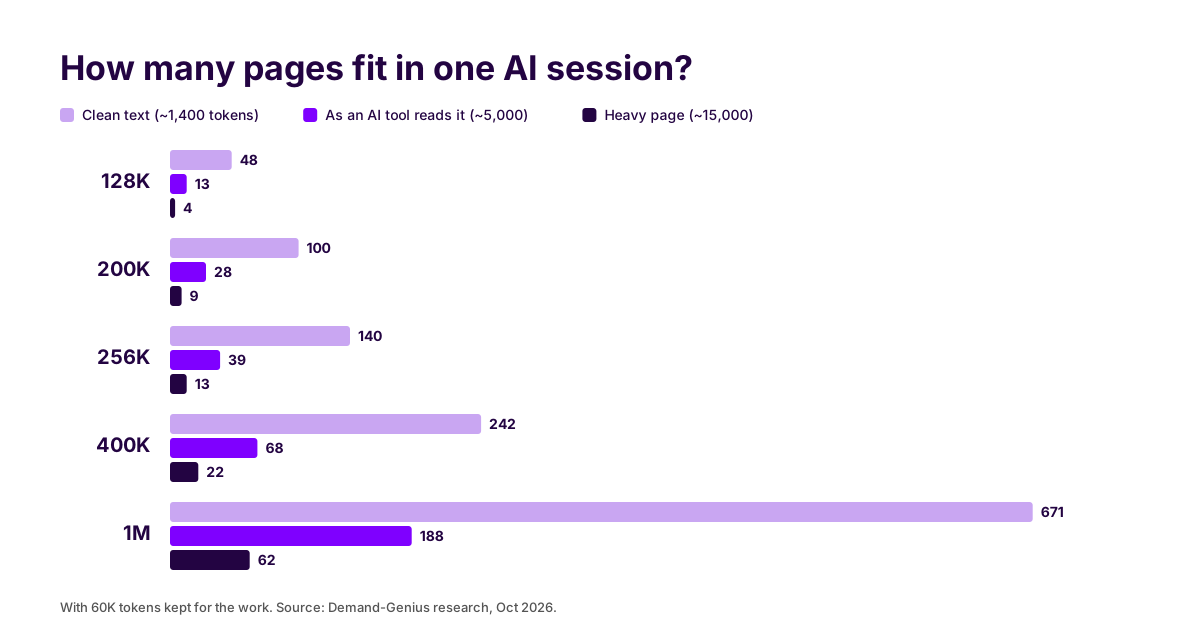
Tokens per page depends on how the page reaches the model. Cleanly extracted text runs about 1,400 tokens a page (938 to 4,384 across the sites we measured). A page as an AI tool fetches it, with navigation, menus and footers turned into text, is far heavier: 4,751 to 6,039 tokens on three smaller sites, and 14,871 on a global site like GoCardless, where localised navigation and footers repeat on every page.
| Context window | Clean text (~1,400 tokens a page) | As an AI tool reads it (~5,000) | Heavy page (~15,000) |
|---|---|---|---|
| 128K | 48 | 13 | 4 |
| 200K | 100 | 28 | 9 |
| 256K | 140 | 39 | 13 |
| 400K | 242 | 68 | 22 |
| 1M | 671 | 188 | 62 |
Windows under 60K leave almost no room once the task has space to work. Even with nothing else in it, a 54K window holds about 38 clean pages or 10 heavy ones.
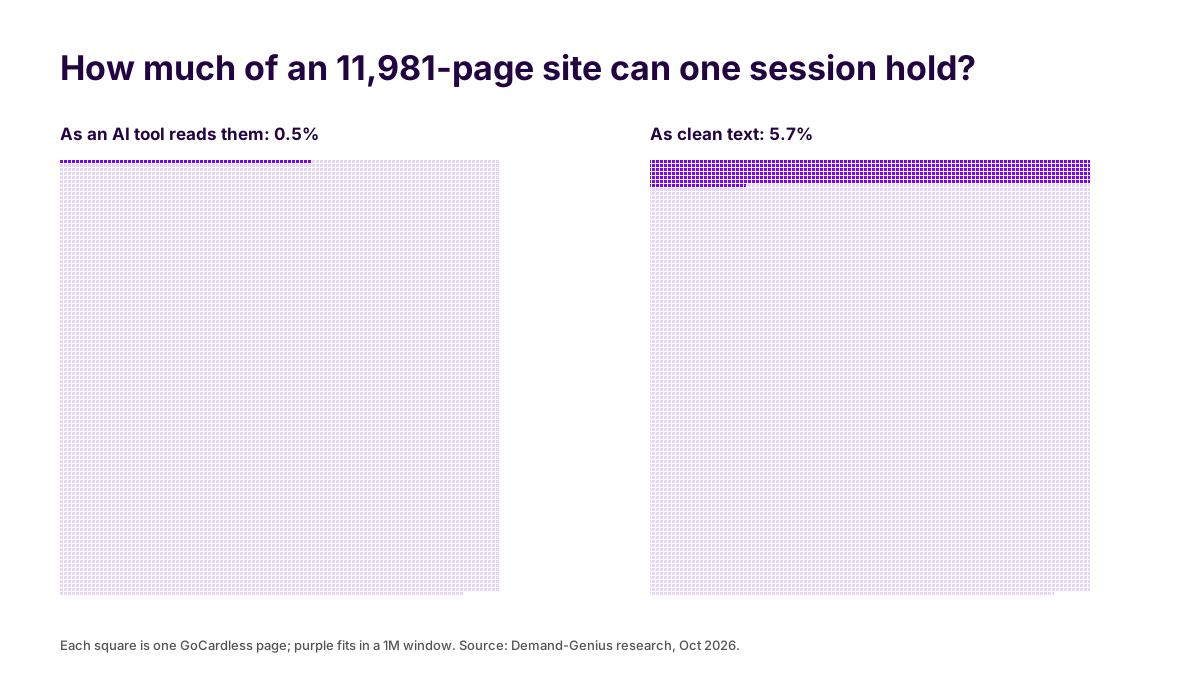
On GoCardless's 11,981-page site, a 1M session holds 63 pages as an AI tool reads them (0.5% of the library), or 684 as clean text (5.7%).
These are ceilings. In practice the useful number is lower.
What happens when the window fills up?
Each product handles it differently:
- Claude summarises earlier messages in a long chat so the conversation can carry on. In Projects, once your files approach the limit, it switches to searching them and pulling in relevant passages instead of reading them whole.
- ChatGPT Enterprise reads the first 110K tokens of a large upload and sends the rest to a search index, with one search per prompt. OpenAI says this "can struggle with complex tasks like summarizing very large documents or comparing multiple large files."
- Gemini warns that going over "could lead to responses that don't take into account all the content provided."
- Through the APIs, an oversized request is refused with an error, or earlier turns are compressed into a summary.
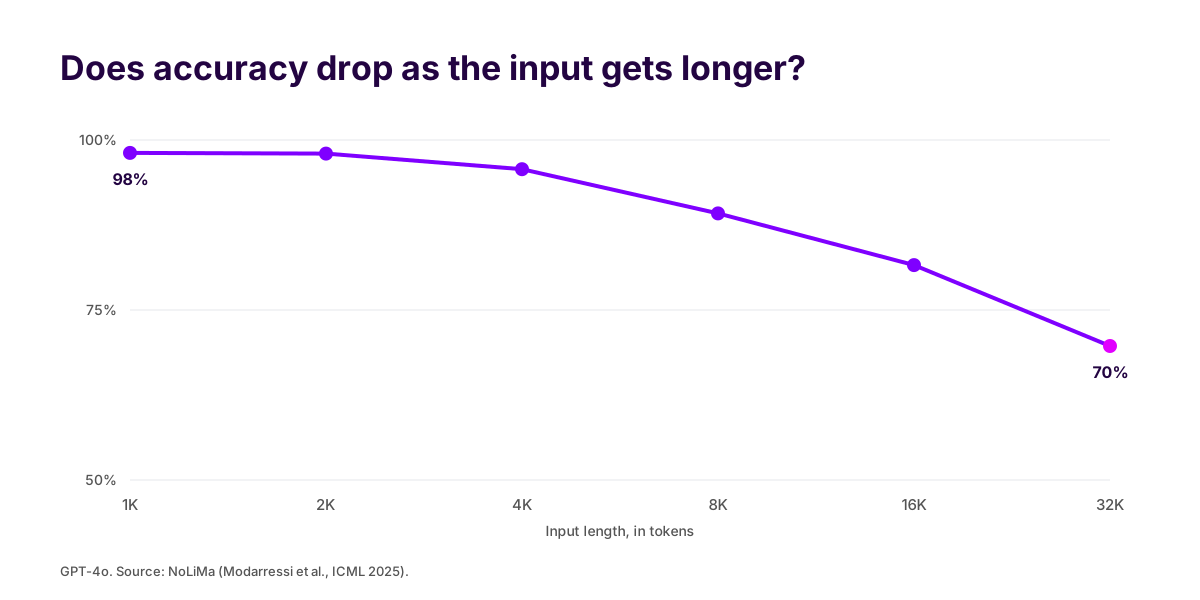
Either way, the answer comes back based on part of what you gave it, usually without saying which part. This is where Marketers can run into trouble. There is also evidence suggesting that as the context window gets full, the quality and accuracy of outputs falls.
Why does this matter for content strategy?
It's easy to ask AI for a content plan without realising how little of your site it has seen. It doesn't read your whole site. It reads what fits, usually whatever it happened to fetch, and reasons over that; usually a small sample, over which it is not typically transparent.
Most of us have had content recommendations from ChatGPT, Claude or a third-party tool that felt a bit generic. That's because they are. They aren't irrelevant, but they have no foundation in what you've already published, meaning they probably overlook critical gaps and opportunities to generate impact by uplifting existing content as well as creating new content.
We measured this. Asked for a content strategy with a one-line prompt, Claude read 5 to 11 pages, >1 to 3% of each library (9 of 11,981 on GoCardless), and backed about one recommendation in ten with evidence from the site. Given a full brief, it built its own crawler in 13 of 16 runs, but on GoCardless that covered 2 to 4% of the site. We wrote a full research report on how you can get the most out of AI for content and/or GEO strategy, looking at how both prompt and context quality impact outputs.
What can you do about it?
- Know your window. Check your plan and mode. The default mode on a cheaper plan holds dozens of pages, not hundreds.
- Choose what goes in. For a narrow question, give the model the specific pages that matter as clean text, and start a new conversation for a new task so old context isn't taking up room. Ask for evidence. Ask which pages the answer is based on, and ask it to back up its recommendations with data.
- Turn the library into data. Demand Genius Content Intelligence turns your entire content library into a context-friendly database, which can improve the amount of content AI considers by as much as 42x. AI queries rich data covering every piece (funnel stage, audience, quality, authority, information gain) and you can even customise the data held to your use case to maximise the quality of outputs.
FAQ
Does a bigger context window fix this? It helps, but it doesn't close the gap. A 1M window holds 60 to 200 pages as AI tools read them, and quality falls as it fills.
Doesn't the AI just search my site? With web access it fetches pages one at a time. Retrieval features pull passages that match your question, which is good for finding a fact and weak for judging a whole library.
Do uploaded files count? Yes. Uploads go into the window until the product switches to retrieval, and from then on the model sees excerpts.
Related
More from the research team


Want this applied to your brand?
Book a free audit. Real analysis of your AI position, no obligation.