Overwhelmed, Unsure, Unproven: Selling GEO in 2026
We surveyed 47 MDs and commercial leaders at B2B agencies on how they package, price and deliver GEO.
Jump to section
- Cause one: GEO is a brand channel being asked to behave like a performance channel
- Why AI sends so little traffic
- Think of AI like your website
- Pipeline can move. Isolating why is the hard part
- Cause two: the discipline is being learned in echo chambers
- How a tactic becomes "the answer"
- Every discipline has its own echo chamber
- Trust research, not stories
- Cause three: expecting certainty from a system that can't give it
- AI says something different to everyone
- What working with directional data looks like
- Moving forward
- 1. Agree what proof looks like before you start
- 2. Stop doing GEO in a silo
- 3. Learn from research, not the feed
- 4. Treat the data as directional, and be disciplined about it
- 5. Diagnose via consistent processes, then tailor what you do
- 6. Ask for the case study
- Where this goes next
- Get the full findings
Over August and September 2026, we surveyed B2B agencies on the commercial side of GEO: how they package it, price it, deliver it and prove it. Three-quarters of respondents run or co-run their agency, and most of those agencies have fewer than 25 people. Most are UK-based. These aren't the agencies that spun up a GEO landing page overnight. They're careful, commercially minded and, for the most part, wary of hype.
What they told us isn't a story about an industry rushing in, and sits in stark contrast to the more bullish (dare we say; “snake oil”) picture that emerges anytime we make the mistake of going on Social Media.
The data showed that regardless of the public stance or existence of a named “GEO product”, uncertainty is commonplace. Agencies that sell GEO and agencies that don't are equally unsure whether it's mostly hype or mostly impact: 3.16 and 3.23 out of 5. Only one of 16 agencies without an offering rejects GEO as a discipline. The rest either believe it matters, are building something, or have deliberately folded it into what they already do.
The story is about a discipline that isn't fully understood yet, and the very different reactions that emerge from three feelings that came up again and again.
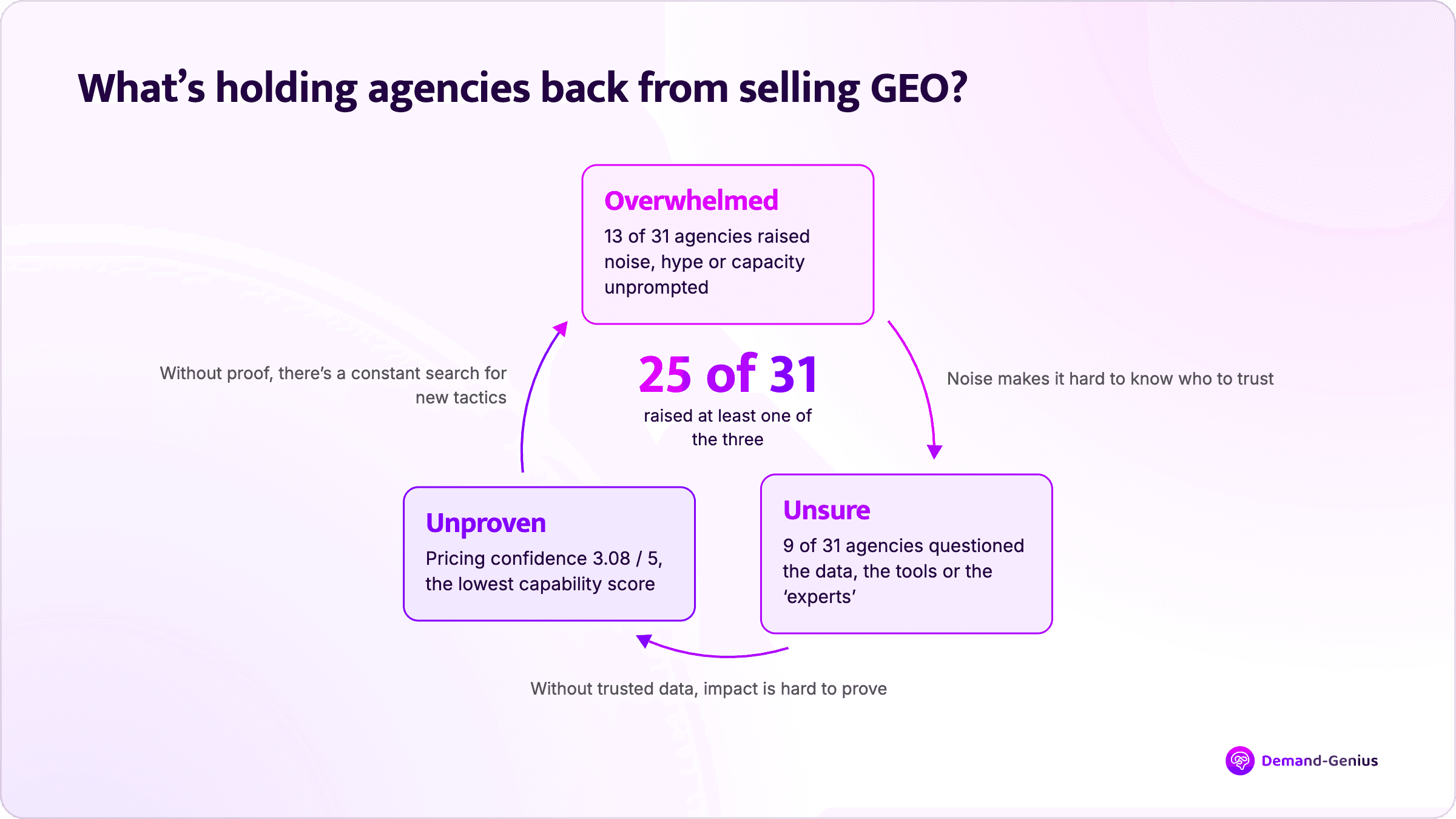
Overwhelmed. There's too much going on: too many tools, tactics and claims, and too little time to sort them. 13 of the 31 agencies that wrote open answers raised noise, hype or capacity unprompted. One PR agency described "overwhelming choice of tools and seemingly no discernible difference between price and quality". Another respondent put it more simply: "The sheer confusion in this space!". Christian Rigg at Eleven Content told us it's "very easy to feel overwhelmed by everything that's going on. And it's very easy to have a team that's feeling overwhelmed."
Unsure. Agencies don't fully trust what they read or the data they see. Confidence in the accuracy of AI visibility data averages 3.50 out of 5, and 11 of the 20 agencies using a third-party tool don't fully know how it decides which prompts to track. "There's no trusted resource for agencies to guide them on the right path forward," one agency founder wrote.
Unproven. Above all, agencies struggle to show that GEO works in the terms clients want. Confidence in pricing is the lowest of the six capability scores we asked about, at 3.08 out of 5. Gareth Hoyle at Marketing Signals summed up the problem: “[With SEO] I can say to somebody, if you give me £10,000 a month, I think I can generate for you 1.2 million per year… With GEO and AI visibility, we're saying give me £10,000 a month and hopefully we'll figure it out."
These three trends feel connected. Overwhelming noise makes it hard to know whom to trust. Without trusted data, it's hard to prove impact. Without proof, every new tool or tactic looks like it might be the answer, and the noise gets louder. Of the 31 agencies that wrote open answers, 25 raised at least one of the three.
None of this is a criticism of the agencies in question. It's what working in a new discipline feels like. We think these feelings can be traced back to three specific causes, and each one can be addressed: what GEO is assumed to be, where agencies learn about it, and what they expect the data to tell them.
If you want to see the raw data, section-by-section, you can download the full report. In this piece, we’ll look at some of the key findings and use our own research to peel back their root causes, what agencies can learn and how these findings should influence your actions going forward.
Cause one: GEO is a brand channel being asked to behave like a performance channel
Clients are bringing GEO briefs to SEO agencies first and foremost. SEO agencies rate GEO's place in their clients' priorities at 3.75 out of 5, against an average of 2.59 across the sample. Brand agencies rate it just 1.60.
One thing that has always been clear from our research is that AI is not a channel in itself, but a reflection of what a brand does across all the channels and surfaces accessible to AI. It encompasses a brand’s positioning, content and reputation. This throws up all sorts of operational challenges for any Agency that is specialised (as most are), in its offering or its operational structure, around either content, reputation or positioning, rather than designed to execute joined up strategies across all three.
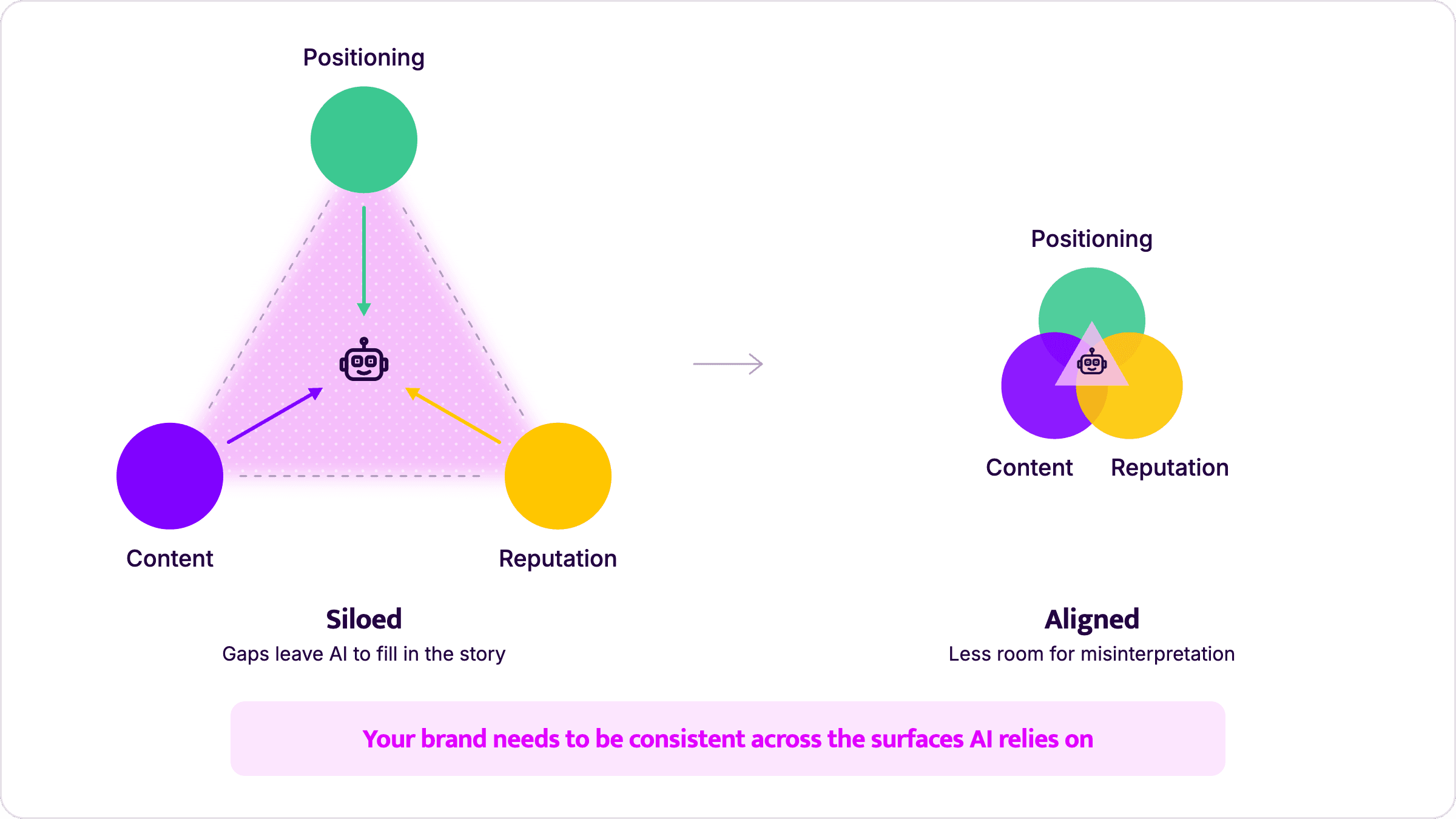
This data shows that while all three contribute to AI visibility, SEO and Content agencies are seeing far more GEO work than brand (positioning) and PR (reputation) agencies. More surprising is that Full Stack agencies, in theory best placed to deliver on a cross-functional challenge, rated it just 2.6 out of 5.
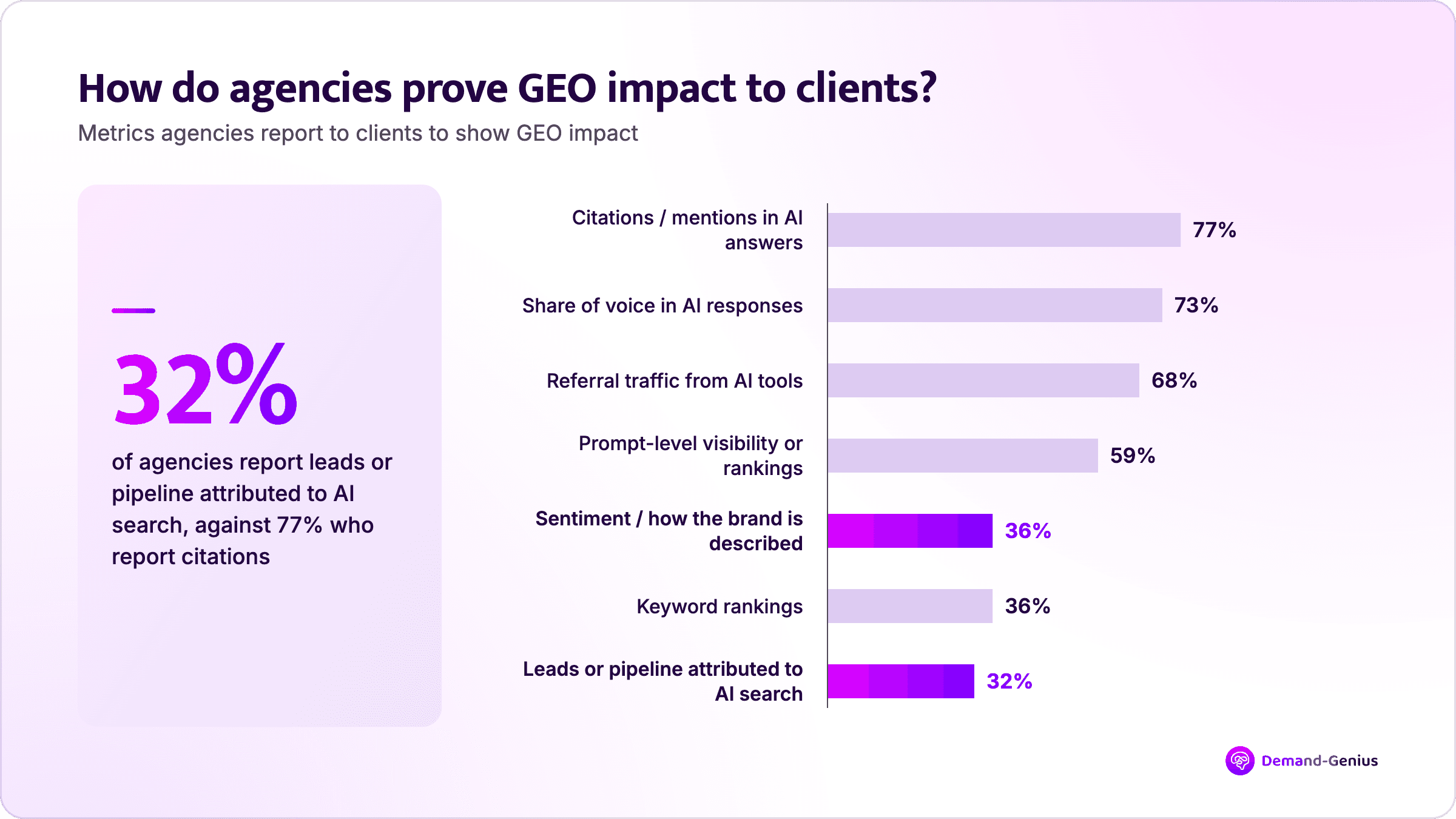
Agencies then report on it the way they'd report on traditional search. Of the 22 agencies that told us what they report, 77% show citations or mentions, 73% share of voice and 68% referral traffic. These are SEO-style metrics. Only 32% show leads or pipeline, and only 36% show how the brand is described.
That's an understandable starting point. It's also, I think, the root of a lot of the frustration. As one survey respondent said: "GEO is a shiny object, and it's often getting placed under 'growth marketing' as a lead gen remit."
Why AI sends so little traffic
One of the most crucial differences between AI and search is that there isn't always a link to click. Even when there is one, it's a citation, not a listing. It's there to support the answer and the entire user experience of the product is designed to keep the person in the conversation, not to send them somewhere else.
Most of the time there isn't even a citation. In our Dark AI research, just 16% of AI responses across complex B2B buying journeys cited a brand. Brands appear mostly at the end of the journey, when the buyer is close to a decision. Earlier on, where most of the influence happens, there's nothing to click.
So GEO is a poor source of traffic volume. What it does produce is a small amount of traffic with very high intent. Semrush found the average AI search visitor was 4.4 times as valuable as an organic search visitor, based on conversion rate. On its own site, Ahrefs found AI search drove 0.5% of visitors but 12.1% of signups, a conversion rate 23 times higher.
That changes the job of the website. Instead of building it to take problem-aware traffic and turn it into solution-aware, high intent buyers, the job is to capture the relatively low volume of already-educated, in-market buyers that AI sends your way.
Think of AI like your website
The way we frame AI with clients is that investing in GEO is like investing in your website. There are two levels to it.
The first is brand reflection. Your website needs to describe you accurately and compellingly, in the way you want the market to see you. It's air cover for everything else in your go-to-market. If your website sucks, nothing works as well.
AI is now the same. Every brand, whatever its size or ambition, needs to ask: does AI describe us the way we'd want it to? More and more, AI will be a buyer's first and most important encounter with your brand, before they ever reach your website.
The second is growth. Once the foundation is right, you can invest in AI as a source of leads and pipeline, just as you would with your website. It takes time and money. Done really well, it can become a moat. But be careful, as chasing hacks and quick wins can damage the brand you're trying to build. Gareth Hoyle at Marketing Signals put it bluntly in relation to a recent trend: "trying to manipulate Reddit for LLM visibility is building on sand, really."
AI can be a growth driver, but it is a brand investment first and foremost.
Pipeline can move. Isolating why is the hard part
None of this means GEO can't drive pipeline. Darryl Sparey at Hard Numbers described "a causal relationship between our expertise on GEO and… opportunities we're getting to pitch" in terms of AI’s impact on their own growth. The difficulty is isolating it. In a complex go-to-market, with several channels and a large budget, you can't separate GEO's contribution cleanly. Not yet, and possibly never, unless the platforms themselves decide to solve the problem.
Even perfect measurement would show a channel that shapes decisions more than it sends visits. Treat it that way from the start, educate clients on what they can and can’t expect from investing in GEO, and recognise that a lack of traffic does not equal a lack of impact.
Cause two: the discipline is being learned in echo chambers
This is, for me, the most important data point in the study. We asked agencies where they go for GEO best practice and research. The top answer was individual thought leaders and creators on LinkedIn, at 69%. The least-used was independent or academic research, at 31%.
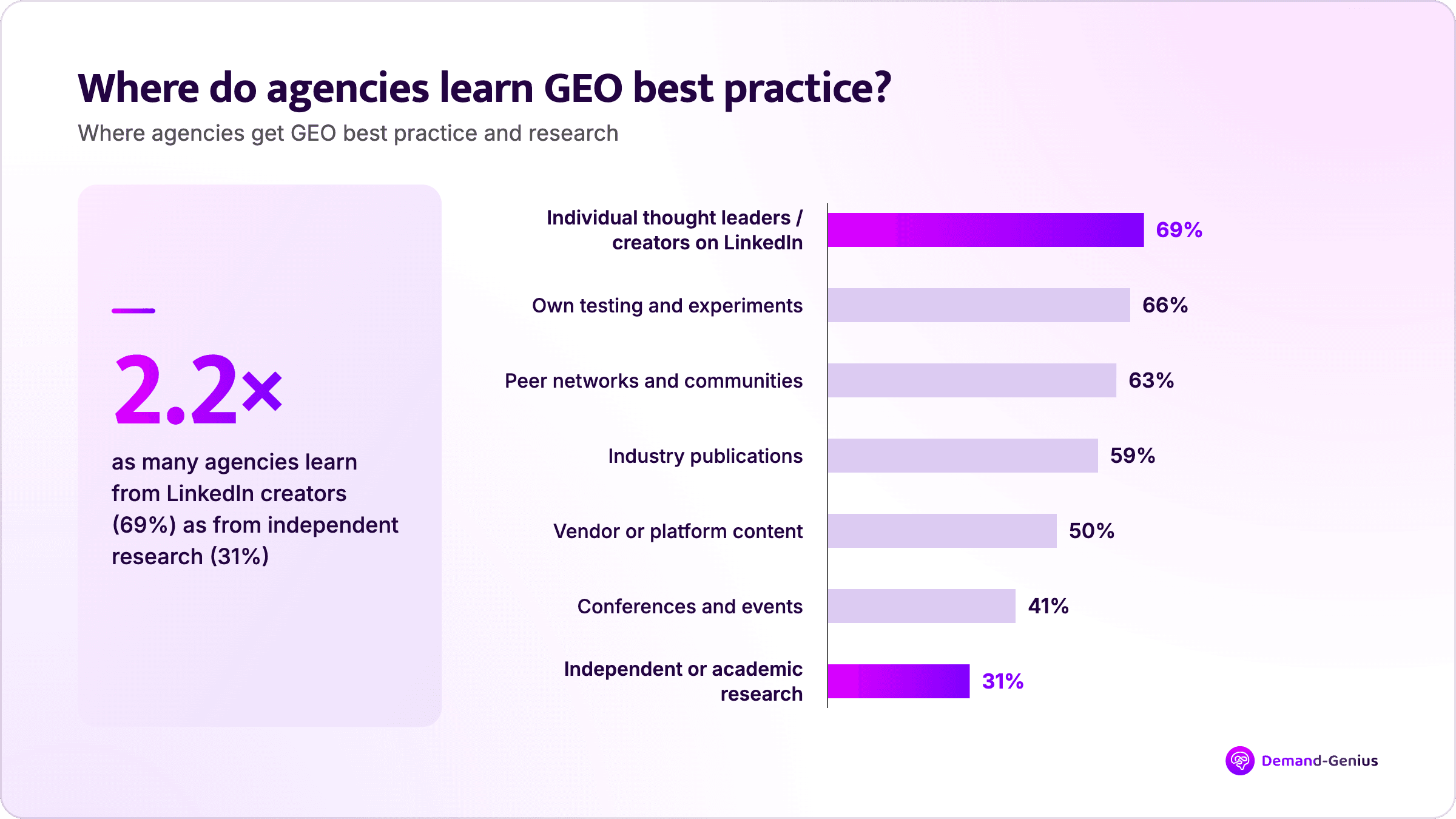
Agencies that sell GEO lean on LinkedIn even more: 15 of 19, against 7 of 13 agencies without an offering. Only 3 of 32 have no go-to source at all. The problem isn't a lack of information. It's a lot of information, mostly second-hand, of very uneven quality.
If social media is where you learn, overwhelm and distrust follow almost automatically. Influencers aren't always the most reliable source, and much of what travels on social media is anecdote rather than research.
How a tactic becomes "the answer"
Ash Lockett at Babel described the problem well; "people selling silver bullets [like] Reddit and Wikipedia and everything else that people say is the hack to gain AI visibility".
There is a common cycle to the trends that lead to a lot of wasted time, energy and budget. Someone notices that Reddit, or YouTube, or Wikipedia, is being cited heavily. It gets posted, shared and repeated without nuance as the “magic bullet” we all really want to exist.
Clients pick this up too. Darryl Sparey at Hard Numbers told us clients often arrive with a channel-specific request because "they will have heard someone say YouTube is a really important source for GEO." His team's answer is to check it against the client's own category: "So actually, is [this] thesis borne out by the data?"
That's the nuance social media loses. A tactic might be effective for one category and one brand, and completely ineffective for another. The sources AI relies on change completely between categories, between brands and over time.
There's a subtler problem too: case studies. Someone does a burst of tactical GEO work, sees an uplift and credits the tactic. Meanwhile the client has been investing heavily in brand, and that's what moved the needle. In a channel this hard to attribute, it's very easy to mistake correlation for causation, and a case study can't tell the two apart. We know that in B2B case studies are compelling, but in a discipline with no repeatable playbook across categories they can be dangerous.
Every discipline has its own echo chamber
Another challenge with learning about GEO via social media is that GEO touches several disciplines at once: PR, brand, SEO, Social and more. Each has its own community in which the same ideas and myopic point of view reverberates. The SEO world talks about SEO tactics and how they affect GEO. The PR world talks about PR tactics. Each (rightly) sees the impact its old playbook has on GEO, but does not see that it is part of the solution because the algorithm does not show them it.
The survey shows the same split in how work is covered. One respondent put the SEO side plainly: "Traditional SEO & Content agencies normally don't touch off-site." Yet a University of Toronto study found that 72.7–74.2% of GPT-4o citations for software products came from earned media.
The echo chamber in which Agencies learn about GEO carries through into their delivery of GEO. We asked agencies with a GEO offering who handles each of eight areas of GEO work, from audit and technical to positioning, earned media, community and social. Only 4 of 23 handle all eight in-house, and only another 5 incorporate all eight, even counting partners. Fifteen leave at least one area out of their GEO strategy entirely. Yet 62% rate themselves 4 or 5 out of 5 on being able to deliver a complete GEO solution internally.
Most agencies have built a GEO offer around the part of the problem their own corner of the industry talks about.
Trust research, not stories
This isn't an argument against anyone who has something to sell, Demand Genius included. The question to ask of any source is simpler: is it genuine research? Does it show its method, its sample and its limits? Does it address the scope of its study and therefore applicability? If everything is case studies and anecdotes, be careful in applying it to your own context.
The answer isn't "trust us". It's to read the deeper studies yourself and form your own view, rather than letting social media do the curation, analysis and interpretation for you.
I can speak from experience here. Our own progress at Demand Genius came when we stopped trying to keep up with the market and moved to a simple loop: run research, learn from it, productise it, put it to work with clients, then repeat. The clearest example is our Conversational Context research. It showed how much an AI's answer depends on the conversation that comes before the prompt you are tracking. So we rebuilt our visibility tracking around it. The entire platform is built around segments, designed to simulate the specific buyer a client is trying to influence. Different segments produce very different results, showing the nuance that is otherwise ironed out of visibility tracking.
Darryl Sparey offered a useful caution here. He says good counsel "doesn't rely on the latest research that says one source is up, one source is down" but on durable principles. We agree. Research is valuable because it establishes principles rooted in evidence, not because it gives you this week's hot channel.
Cause three: expecting certainty from a system that can't give it
The third cause is about data. Agencies want AI visibility data to give a definite answer, the way rank tracking on Google does. The systems underneath don't work that way.
In the survey, trust in data followed understanding of the tool, not how much was spent on it. Agencies using an off-the-shelf tool who fully know how it picks prompts rated its accuracy 4.00 out of 5. Those who only roughly know rated it 1.67. Agencies that built their own scored 4.00. It’s a small sample, but it is interesting that investing in specialised solutions does not lead to higher confidence in the data.
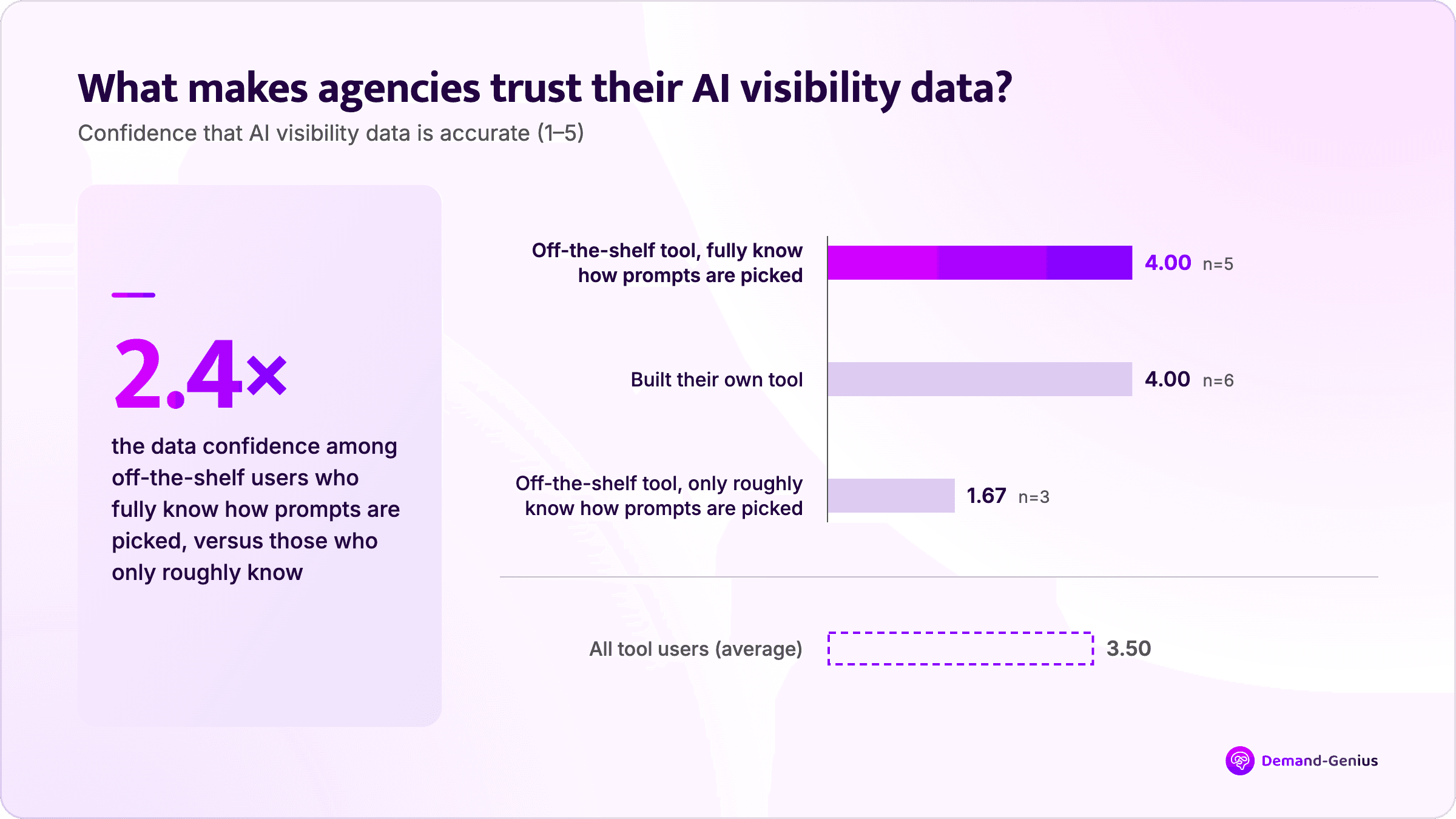
Christian Rigg at Eleven Content was blunt about why: "Most tools run a prompt a day — way, way, way below what's needed to achieve statistical significance, and we're talking margins of error upwards of 50-60%."
AI says something different to everyone
Our own research points the same way, for different reasons. In our cross-model Conversational Context study of 1,880 multi-turn conversations across four models, "62 of 64 tests came back with a statistically significant shift" when the conversation leading up to a question changed. The same question gets a different answer depending on who's asking and what they've already said.
Gareth Hoyle pointed to this exact point: "even the analytics that we get today is still all kind of cold start," with no account of the memory and personalisation real users carry.
Our new segment-based tracking improves this, but we are still very open that we do not believe we will ever give you a truly accurate reflection of what your buyers see in AI conversations.
Any AI visibility number is a sample, not a measurement. It points in a direction. Better tooling can make that direction more reliable, but it can't make it certain. Expecting certainty is what turns known limitations in the data into distrust.
What working with directional data looks like
Once you accept you'll never capture the exact prompt and context a buyer uses, the question changes. You stop asking "what does this prompt show?" and start asking "how do we build samples representative enough to make good decisions?"
Our answer has been to stop tracking one-off prompts and build clusters instead. A cluster is a moment where you want to be visible. It might be a buyer job, such as building a shortlist or comparing vendors. Or it might be a category entry point: the moment someone comes into the market. We track a sample of prompts in each cluster, each a different way a buyer might approach that moment. We simulate the context of a specific buyer segment as closely as we can. It won't be perfect, but it gets closer than a bare prompt run without context.
Each prompt is just a directional sample, and the reporting happens at cluster level, where the signal is stronger.
It changes how you talk to clients, too. Stop presenting prompts, and stop building roadmaps around individual prompts. Clients don't think in prompts. They think in moments: when buyers are building a shortlist, are we on it? When they're comparing us with competitors, what does AI say? When they first realise they have a problem we can solve, does the solution it suggests lead into our product?
Suddenly directional data answering critical questions can be compelling, and hammer home the need to act.
"It's all directional" shouldn't become a license to ignore measurement altogether. Directional data used with discipline by experts can be immensely valuable.
Quick Hits: Other Key findings
These are the findings we think matter most. You can see the full results, question by question, by downloading the full report.
1. Agencies selling GEO are no more convinced it works than agencies that don't
Hype vs impact scores out of 5: 3.16 for adopters, 3.23 for non-adopters. Among adopters, belief in GEO shows no link to pricing confidence.
The market broadly agrees on GEO’s importance, impact and current uncertainties. The only real difference between Agencies is the urgency to capture the demand.
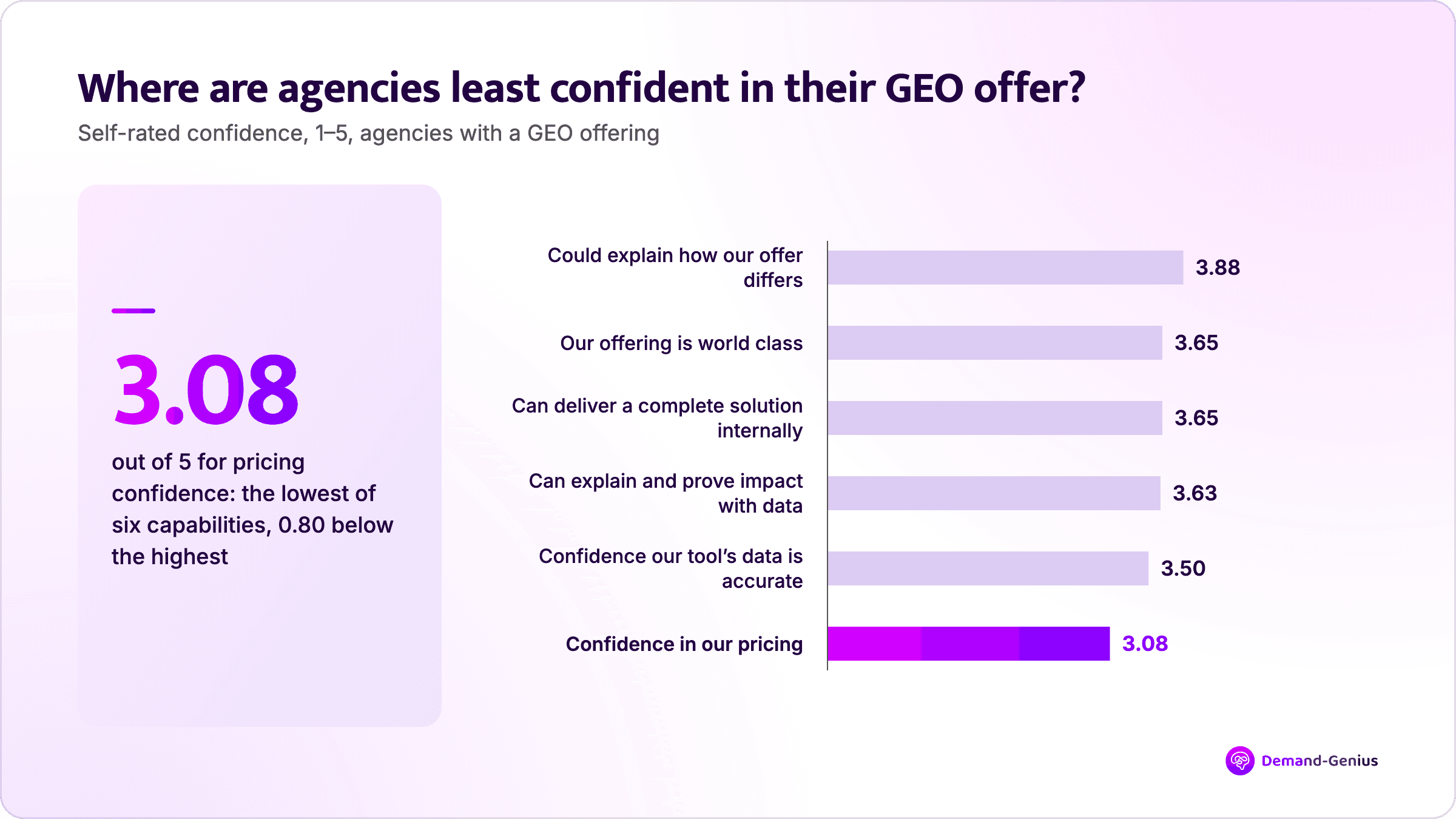
2. Pricing is the capability agencies feel least confident in
3.08 out of 5, the lowest of six self-rated capabilities. Only 29% are confident their price is right
Agencies feel more confident in their ability to deliver value via GEO than to capture it.
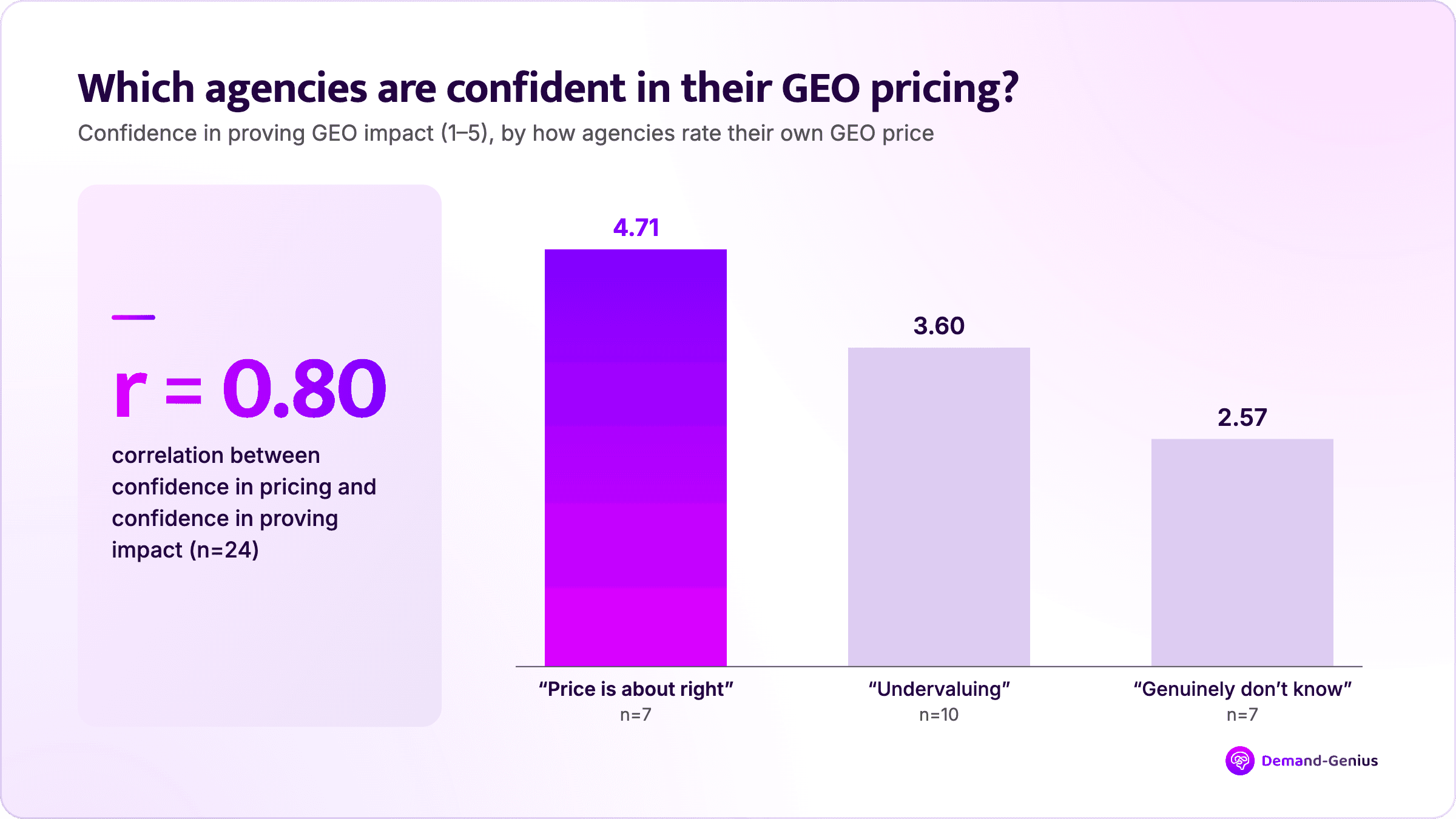
3. Agencies that can prove impact are the ones confident in their price
Confidence in proving impact: 4.71 for agencies whose price is "about right", 2.57 for those who "don't know".
Pricing confidence comes from figuring out exactly what you are delivering for clients.
4. Only a third of agencies report pipeline to clients
77% report citations or mentions; 32% report leads or pipeline.
Most reporting measures visibility, not commercial outcomes.
5. Clients bring GEO to content and SEO agencies, rarely to brand agencies
Share of agencies seeing GEO in more than 25% of briefs: Content 4 of 5, SEO 3 of 4, PR 2 of 9, brand 0 of 5
If GEO is a mix of Positioning, Content and Reputation, then it’s Content clients focus on.
6. LinkedIn creators are agencies' top source; independent research is the least used
69% vs 31%
The playbook is being written by content marketing, in an echo chamber.
7. Trust in tool data depends on understanding the tool, not on building versus buying
Accuracy confidence: off-the-shelf users who fully know how prompts are picked 4.00; those who roughly know 1.67; builders 4.00
It’s important your team understands how visibility data is collected, and the limitations, so they can act with confidence.
8. Nobody's hiring for GEO yet
3 of 33 agencies hired someone specifically for it; 18 trained existing staff
GEO is being absorbed into existing teams.
9. Agencies without an offering aren't sceptics
1 of 16 rejects GEO as a discipline. The top blockers are "can't tell what actually works" and "no clear methodology"; 7 of 16 deliberately fold it into existing services
What's holding them back is evidence, not belief.
Moving forward
None of the three causes we have identified needs a breakthrough to fix. Each needs a change in approach. Here's what we think helps.
1. Agree what proof looks like before you start
Proving pipeline impact is the thing agencies most want. Attribution and commercial data was the most common answer when we asked what would take their GEO offering to the next level. Unless AI platforms themselves address it (which we do not think is likely), this is unlikely to be fully solved. Any measurement you rely on is likely to undersell GEO’s impact, given that 84% of AI responses in complex buyer journeys produce no brand citations (and therefore, no traffic).
So agree the measure of success at the outset, using the two levels from earlier. For brand reflection, success is AI describing the client the way they want to be seen, it’s branded search, and it’s improved sentiment for key buying criteria. For growth, it's pipeline, with honest caveats about how much can be isolated. We find that self-reported attribution is the best way to capture attribution.
2. Stop doing GEO in a silo
Most businesses are built around channel specialisms. That might be a PR, SEO or paid agency, or a full-service agency organised into channel teams. That structure isn't well suited to GEO, because the problem sits across channels. Content, reputation and positioning all shape what AI says about a brand.
If you want to do GEO really well, and make it a calling card, think seriously about how those specialisms will work together. That will look different for different agencies:
- Collaboration across teams. Build stronger working links and shared goals between existing teams.
- A generalist owner. Give ownership to a strategist, or a project lead who can draw on each team's expertise. You keep the benefit of your specialisms and cover what the problem requires.
- Partnerships. Work with complementary agencies on projects or campaigns that together produce a better outcome.
Whichever route you choose, have a plan to make sure your work is supported, not undermined, by what's happening at the other points of the triangle.
3. Learn from research, not the feed
Shift the balance of where you learn. Read the deeper studies, run structured tests of your own, and form your own view. Treat case studies and confident posts with care, and ask of every source whether it shows its method and limitations.
4. Treat the data as directional, and be disciplined about it
Know how your tool chooses prompts. Track moments, not individual prompts. Use enough samples per moment, and report at that level, in terms clients care about. Educate your team on how to extract useful and reliable signals from imperfect data, and build the internal expertise needed to build nuanced client strategies.
5. Diagnose via consistent processes, then tailor what you do
Agencies with a consistent way of diagnosing, and delivery tailored to each client, were the most confident on both price (3.70) and proving impact (4.30). Agencies still working out their approach scored 2.33 on both. Repeatable diagnosis seems to matter more than a repeatable set of tactics.
6. Ask for the case study
Seven of 20 agencies have never asked a client to let them publicise GEO work. The five who found it straightforward were more confident on pricing (4.4 against 2.29 for those who haven't tried), on proving impact (5.0 against 2.86) and on the quality of their offering (4.4 against 3.14). We warned that case studies can be a dangerous source of insights and best practices, but they remain compelling and clearly help agencies to feel confident in their offer and price.
Where this goes next
We don't know exactly where this market goes, and I don't think anyone honestly does. What we do know is that we'll keep trying to understand it better: through our own research, by learning from other people's research, including academic studies, and by constantly reworking our product and services to reflect what we learn. We'd encourage agencies to do the same. In a discipline this young, the ability to keep learning is worth more than any single playbook.
If you would like to speak to us about how you can leverage our research, technology and expertise to differentiate and grow your own GEO offering, get in touch!
Get the full findings
This piece is our interpretation. The full report has every chart, data point and quote across the market, packaging, pricing, method, coverage, tooling and non-adopters, plus four agency spotlights.
Thank you to everyone who took part, and to the 17 agencies that agreed to be named: THINKINK, Streets Consulting, Midnight, Babel PR, Big Games Machine, PRLab, Signifly, Search Seven, Marketing Signals, Isoline Communications, Kyn, Marketing Managed, Hard Numbers, Compound Partners, Collective Content, Eleven Content and Moon at Dawn.
Methodology
How we built this
Method. The Demand-Genius Agency Survey ran online from August to 18 September 2026. It received 48 responses, 30 of them complete. One near-empty partial response was excluded, leaving 47 people at 46 agencies; two respondents came from the same agency. Agencies with a named GEO offering answered questions on packaging, pricing, method, coverage and tooling. Agencies without one (16–17) answered a separate section. Everyone answered the questions on the market and sources, and the open questions. Every figure is calculated from the raw responses, with bases per question. Below 20 responses we report counts, and subgroup comparisons should be read as directional. Open answers were coded by us. Four recorded interviews (with Babel, Eleven Content, Hard Numbers and Marketing Signals) are used for colour and argument, not as data.
Sample. Respondents are self-selected and mostly founder-led: 77% are founders, CEOs or MDs, and 77% of agencies have fewer than 25 people. About three-quarters are UK-based, and PR is the largest specialism (30%). The findings describe independent B2B agencies, not holding companies or large networks.
How AI was used. AI helped us format the data and extract themes. Every figure comes directly from the raw responses, and every quote is reproduced from the survey or interview transcripts. Ellipses mark cuts.
Limitations of this study
- Who we reached. 47 people at 46 agencies is a meaningful sample, but it isn't complete. It leans heavily towards smaller, independent agencies: 77% have fewer than 25 people. Smaller agencies are more likely to be channel specialists than full-stack, so the picture is partly shaped by specialists. We'd expect it to look different at the large networks and holding companies, and that's the next group we'd like to hear from.
- Where we reached them. About three-quarters of respondents are UK-based. We don't think conditions are drastically different elsewhere, but we haven't tested that.
- Who chose to answer. Respondents opted in, mostly through our own network and outreach. Agencies already thinking about GEO were probably more likely to take part, so this is not a random sample of the agency market.
- Small groups within the sample. Some questions were only asked of agencies with a GEO offering (around 20–26 answered each), and some comparisons split that group further. Where a group has fewer than 20 agencies, we report counts and treat the differences as directional, not conclusive.
- Self-reported, not measured. Confidence, pricing and capability scores are agencies' own assessments. They tell us how agencies feel about their GEO work, not how well it actually performs for clients.
- One side of the market. We asked agencies, not their clients. Client demand and expectations are reported second-hand.
- A snapshot. The survey ran in August and September 2026, in a market that moves quickly. We plan to repeat it annually to track how the picture changes.
Related
More from the research team
.png&w=1920&q=75)


Want this applied to your brand?
Book a free audit. Real analysis of your AI position, no obligation.